

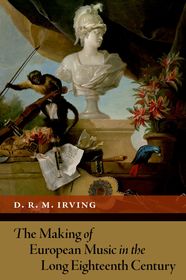
The Making of European Music in the Long Eighteenth Century
Series: New Cultural History of Music;
- Publisher's listprice GBP 54.00
-
24 381 Ft (23 220 Ft + 5% VAT)
The price is estimated because at the time of ordering we do not know what conversion rates will apply to HUF / product currency when the book arrives. In case HUF is weaker, the price increases slightly, in case HUF is stronger, the price goes lower slightly.
- Discount 10% (cc. 2 438 Ft off)
- Discounted price 21 943 Ft (20 898 Ft + 5% VAT)
Subcribe now and take benefit of a favourable price.
Subscribe
24 381 Ft

Availability
printed on demand
Why don't you give exact delivery time?
Delivery time is estimated on our previous experiences. We give estimations only, because we order from outside Hungary, and the delivery time mainly depends on how quickly the publisher supplies the book. Faster or slower deliveries both happen, but we do our best to supply as quickly as possible.
Product details:
- Publisher OUP USA
- Date of Publication 20 December 2024
- ISBN 9780197632185
- Binding Hardback
- No. of pages352 pages
- Size 231x165x35 mm
- Weight 590 g
- Language English
- Illustrations 19 illustrations 564
Categories
Short description:
In this book, author D. R. M. Irving traces the emergence of such large-scale categories as "European music" and "Western music," showing how they originate from self-fashioning in contexts of intercultural comparison outside the European continent rather than the resolution of national aesthetic differences within it. Taken as a whole, this study demonstrates how reductive labels for the musics of a continent or a hemisphere often imply homogeneity and essentialism, and how a renewed critique of primary sources can help dismantle historiographical constructs that arose within narratives of musical pasts involving Europe.
MoreLong description:
Musical representations of Europe in myth and allegory are well known, but when and under what circumstances did the words "European" and "music" become linked together? What did the resulting term mean in music before 1800 and how did it evolve into the label "Western music," which features so prominently in pedagogical and scholarly discourses?
In The Making of European Music in the Long Eighteenth Century, author D. R. M. Irving traces the emergence of such large-scale categories in Western European thought. Beginning in the 1670s, Jesuit missionaries in China began to refer to "European music," and for the next hundred years the term appeared almost exclusively in comparison with musics from other parts of the world. It entered common use from the 1770s, and in the 1830s became synonymous with a new concept of "Western music." Western European writers also associated these terms with notions of "progress" and "perfection." Meanwhile, changing ideas about "modern" Europe's cultural relationship with classical antiquity, together with theories that systematically and condescendingly racialized people from other continents, influenced the ways that these scholars imagined and interpreted musical pasts around the globe.
Irving weaves his analyses throughout the book's historical examinations, suggesting that "European music" originates from self-fashioning in contexts of intercultural comparison outside the continent, rather than from the resolution of national aesthetic differences within it. He shows that "Western music" as understood today arose in line with the growth of Orientalism and increasing awareness of musics of "the East." All such reductive terms often imply homogeneity and essentialism, and Irving asks what a reassessment of their beginnings might mean for music history.
Taken as a whole, the book shows how a renewed critique of primary sources can help dismantle historiographical constructs that arose within narratives of musical pasts involving Europe.
This impressive example of cultural history is a brilliant book and also a necessary one.
Table of Contents:
Acknowledgments
Note on Sources
Introduction: Musics of Continents and Hemispheres
Part I: "Europe" in Music, Music in "Europe"
Introduction
1. Musical Constructions of Europe in Myth and Allegory
2. Europe as Place: Music and the Imagined Extent of a Continent
Part II: "European Music"
Introduction
3. Europeans, "Franks," and "Their" Musics
4. The Emergence of the "European Music" Concept
PART III: "Modern European Music" and "Western Music"
Introduction
5. "Modern" Europe and "Ancient" Others in Musical Thought
6. Accidental Occident: The Setting of "the West" in Music History
Epilogue
Bibliography
Index

