

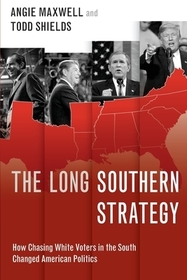
The Long Southern Strategy
How Chasing White Voters in the South Changed American Politics
- Publisher's listprice GBP 26.99
-
12 185 Ft (11 605 Ft + 5% VAT)
The price is estimated because at the time of ordering we do not know what conversion rates will apply to HUF / product currency when the book arrives. In case HUF is weaker, the price increases slightly, in case HUF is stronger, the price goes lower slightly.
- Discount 10% (cc. 1 219 Ft off)
- Discounted price 10 967 Ft (10 445 Ft + 5% VAT)
Subcribe now and take benefit of a favourable price.
Subscribe
12 185 Ft

Availability
Estimated delivery time: In stock at the publisher, but not at Prospero's office. Delivery time approx. 3-5 weeks.
Not in stock at Prospero.
Why don't you give exact delivery time?
Delivery time is estimated on our previous experiences. We give estimations only, because we order from outside Hungary, and the delivery time mainly depends on how quickly the publisher supplies the book. Faster or slower deliveries both happen, but we do our best to supply as quickly as possible.
Product details:
- Publisher OUP USA
- Date of Publication 15 April 2021
- ISBN 9780197579039
- Binding Paperback
- No. of pages560 pages
- Size 155x234x33 mm
- Weight 771 g
- Language English 96
Categories
Short description:
In The Long Southern Strategy, Angie Maxwell and Todd Shields trace the consequences of the GOP's decision to court white voters in the South. Over time, Republicans adopted racially coded, anti-feminist, and evangelical Christian rhetoric and policies, making its platform more southern and more partisan, and the remodel paid off. This strategy has helped the party reach new voters and secure electoral victories, up to and including the 2016 election. Now, in any Republican primary, the most southern-presenting candidate wins, regardless of whether that identity is real or performed. Using an original and wide-ranging data set of voter opinions, Maxwell and Shields examine what southerners believe and show how Republicans such as Donald Trump stoke support in the South and among southern-identified voters across the nation.
MoreLong description:
The Southern Strategy was but one in a series of decisions the GOP made not just on race, but on feminism and religion as well, in what Angie Maxwell and Todd Shields call the "Long Southern Strategy."
The Southern Strategy is traditionally understood as a Goldwater and Nixon-era effort by the Republican Party to win over disaffected white voters in the Democratic stronghold of the American South. To realign these voters with the GOP, the party abandoned its past support for civil rights and used racially coded language to capitalize on southern white racial angst. However, that decision was but one in a series of decisions the GOP made not just on race, but on feminism and religion as well, in what Angie Maxwell and Todd Shields call the "Long Southern Strategy."
In the wake of Second-Wave Feminism, the GOP dropped the Equal Rights Amendment from its platform and promoted traditional gender roles in an effort to appeal to anti-feminist white southerners, particularly women. And when the leadership of the Southern Baptist Convention became increasingly fundamentalist and politically active, the GOP tied its fate to the Christian Right. With original, extensive data on national and regional opinions and voting behavior, Maxwell and Shields show why all three of those decisions were necessary for the South to turn from blue to red.
To make inroads in the South, however, GOP politicians not only had to take these positions, but they also had to sell them with a southern "accent." Republicans embodied southern white culture by emphasizing an "us vs. them" outlook, preaching absolutes, accusing the media of bias, prioritizing identity over the economy, encouraging defensiveness, and championing a politics of retribution. In doing so, the GOP nationalized southern white identity, rebranded itself to the country at large, and fundamentally altered the vision and tone of American politics.
Based on extensive research, including qualitative and quantitative scholarship (with survey data included), the book is filled with insights into recent history and the current state of politics in the South and the nation. Although challenging, it largely avoids disciplinary jargon and therefore is accessible to a broader audience. Highly relevant, and deserving of a broad readership. ... Summing up: Highly recommended
Table of Contents:
Acknowledgments
List of Figures and Tables
Notes on Data and Appendices
Introduction: The Long Southern Strategy Explained
Part I: The Grand Bargain
Chapter 1: The Not-So-New Southern Racism
Chapter 2: Southern White Privilege
Chapter 3: The Myth of Post-Racial America
Part II: Operation Dixie Family Values
Chapter 4: The Not-So-New Southern Sexism
Chapter 5: Southern White Patriarchy
Chapter 6: The Myth of the Gender Gap
Part III: Politics and the Pulpit
Chapter 7: The Not-So-New Southern Religion
Chapter 8: Southern White Fundamentalism
Chapter 9: The Myth of the Social Conservative
Conclusion: An Echo, Not a Choice
Appendix A: Survey Instruments
Appendix B: Sample Sizes
Appendix C: Significance Tests
Figures and Tables
List of Captions

