

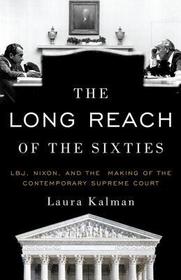
The Long Reach of the Sixties
LBJ, Nixon, and the Making of the Contemporary Supreme Court
- Publisher's listprice GBP 29.99
-
13 540 Ft (12 895 Ft + 5% VAT)
The price is estimated because at the time of ordering we do not know what conversion rates will apply to HUF / product currency when the book arrives. In case HUF is weaker, the price increases slightly, in case HUF is stronger, the price goes lower slightly.
- Discount 10% (cc. 1 354 Ft off)
- Discounted price 12 186 Ft (11 606 Ft + 5% VAT)
Subcribe now and take benefit of a favourable price.
Subscribe
13 540 Ft

Availability
Estimated delivery time: In stock at the publisher, but not at Prospero's office. Delivery time approx. 3-5 weeks.
Not in stock at Prospero.
Why don't you give exact delivery time?
Delivery time is estimated on our previous experiences. We give estimations only, because we order from outside Hungary, and the delivery time mainly depends on how quickly the publisher supplies the book. Faster or slower deliveries both happen, but we do our best to supply as quickly as possible.
Product details:
- Publisher OUP USA
- Date of Publication 8 October 2019
- ISBN 9780190079116
- Binding Paperback
- No. of pages488 pages
- Size 226x145x27 mm
- Weight 635 g
- Language English
- Illustrations 31 illus. 0
Categories
Short description:
In The Long Reach of the Sixties, legal historian Laura Kalman explores the Supreme Court nomination and confirmation battles of the late 1960s and early 1970s and shows how they have haunted--indeed, scarred--the Supreme Court appointments process ever since.
MoreLong description:
The Warren Court of the 1950s and 1960s was the most liberal in American history. Yet within a few short years, new appointments redirected the Court in a more conservative direction, a trend that continued for decades. However, even after Warren retired and the makeup of the court changed, his Court cast a shadow that extends to our own era.
In The Long Reach of the Sixties, Laura Kalman focuses on the late 1960s and early 1970s, when Presidents Johnson and Nixon attempted to dominate the Court and alter its course. Using newly released--and consistently entertaining--recordings of Lyndon Johnson's and Richard Nixon's telephone conversations, she roots their efforts to mold the Court in their desire to protect their Presidencies. The fierce ideological battles--between the executive, legislative, and judicial branches--that ensued transformed the meaning of the Warren Court in American memory. Despite the fact that the Court's decisions generally reflected public opinion, the surrounding debate calcified the image of the Warren Court as activist and liberal. Abe Fortas's embarrassing fall and Nixon's campaign against liberal justices helped make the term "activist Warren Court" totemic for liberals and conservatives alike.
The fear of a liberal court has changed the appointment process forever, Kalman argues. Drawing from sources in the Ford, Reagan, Bush I, and Clinton presidential libraries, as well as the justices' papers, she shows how the desire to avoid another Warren Court has politicized appointments by an order of magnitude. Among other things, presidents now almost never nominate politicians as Supreme Court justices (another response to Warren, who had been the governor of California). Sophisticated, lively, and attuned to the ironies of history, The Long Reach of the Sixties is essential reading for all students of the modern Court and U.S. political history.
Kalman deftly argues that confirmation hearings with little substance, nominees selected exclusively from Harvard and Yale, and the heavy emphasis on past judicial experience are a direct consequence of the lessons presidents have learned from this critical period.
Table of Contents:
Preface
I: A New President Seeks Power: 1963-65
II: Musical Chairs, 1965-66
III: Bogeyman, 1966-1968
IV: "A Man's Reach Should [Not] Exceed His Grasp:" Summer and Fall, 1968
V: The Last Days of the Warren Court, 1969-70
VI: "Southern Discomfort," 1969-70
VII: The Lost Ball Game, Or How Not to Choose Two Justices, 1971
Epilogue

