

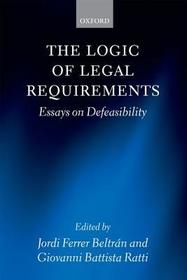
The Logic of Legal Requirements
Essays on Defeasibility
- Publisher's listprice GBP 105.00
-
50 163 Ft (47 775 Ft + 5% VAT)
The price is estimated because at the time of ordering we do not know what conversion rates will apply to HUF / product currency when the book arrives. In case HUF is weaker, the price increases slightly, in case HUF is stronger, the price goes lower slightly.
- Discount 10% (cc. 5 016 Ft off)
- Discounted price 45 147 Ft (42 998 Ft + 5% VAT)
Subcribe now and take benefit of a favourable price.
Subscribe
50 163 Ft

Availability
printed on demand
Why don't you give exact delivery time?
Delivery time is estimated on our previous experiences. We give estimations only, because we order from outside Hungary, and the delivery time mainly depends on how quickly the publisher supplies the book. Faster or slower deliveries both happen, but we do our best to supply as quickly as possible.
Product details:
- Publisher OUP Oxford
- Date of Publication 13 September 2012
- ISBN 9780199661640
- Binding Hardback
- No. of pages434 pages
- Size 240x161x31 mm
- Weight 806 g
- Language English 0
Categories
Short description:
Does the law contain implicit exceptions to its own rules? If so, what consequence does that have for understanding the relationship between law and morality? This collection gathers leading legal philosophers to analyse the logical structure of legal norms, advancing the understanding of the general philosophy of law.
MoreLong description:
When a legal rule requires us to drive on the right, notarize our wills, or refrain from selling bootleg liquor, how are we to describe and understand that requirement? In particular, how does the logical form of such a requirement relate to the logical form of other requirements, such as moral requirements, or the requirements of logic itself? When a general legal rule is applied or distinguished in a particular case, how can we describe that process in logical form? Such questions have come to preoccupy modern legal philosophy as its methodology, drawing on the philosophy of logic, becomes ever more sophisticated.
This collection gathers together some of the most prominent legal philosophers in the Anglo-American and civil law traditions to analyse the logical structure of legal norms. They focus on the issue of defeasibility, which has become a central concern for both logicians and legal philosophers in recent years.
The book is divided into four parts. The first section is devoted to unravelling the basic concepts related to legal defeasibility and the logical structure of legal norms, focusing on the idea that law, or its components, are liable to implicit exceptions, which cannot be specified before the law's application to particular cases. Part two aims to disentangle the main relations between the issue of legal defeasibility and the issue of legal interpretation, exploring the topic of defeasibility as a product of certain argumentative techniques in the law. Section 3 of the volume is dedicated to one of the most problematic issues in the history of jurisprudence: the connections between law and morality. Finally, section 4 of the volume is devoted to analysing the relationships between defeasibility and legal adjudication.
The book The Logic of Legal Requirements is an impressive and engaging collection of high quality essays on legal defeasibility. It features twenty-two contributions resulting in a comprehensive, well structured as well as very challenging investigation of the subject.
Table of Contents:
Legal Defeasibility: An Introduction
Part I: General Features of Defeasibility in Law and Logic
Defeasibility and Legality: A Survey
On Law and Logic
Defeasibility, Contributory Conditionals, and Refinement of Legal Systems
Is Defeasibility an Essential Property of Law?
Against Defeasibility of Legal Rules
Defeasibility in Legal Reasoning
Defeasible Properties
Part II: Defeasibility and Interpretation
Defeasibility and Legal Indeterminacy
Defeasibility, Axiological Gaps, and Interpretation
Defeasibility and Open Texture
Exceptions
Acts, Normative Formulations, and Defeasible Norms
Part III: Defeasibility and the Conceptions of Law
Legal Defeasibility and the Connection between Law and Morality
Rules, Principles, and Defeasibility
Defeasibility and Legal Positivism
True Exceptions: Defeasibility and Particularism
Principles, Conflicts, and Defeats: An Approach from a Coherentist Theory
Reasons for Action and Defeasibility
Part IV: Defeasibility and Adjudication
Legislation and Adjudication
Defeasibility and Adjudication
Legal Defeasibility in Context and the Emergence of Substantial Indefeasibility
Defeasible Rules and Interpersonal Accountability

