

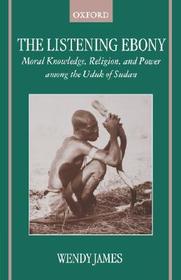
The Listening Ebony
Moral Knowledge, Religion, and Power among the Uduk of Sudan
- Publisher's listprice GBP 102.50
-
46 278 Ft (44 075 Ft + 5% VAT)
The price is estimated because at the time of ordering we do not know what conversion rates will apply to HUF / product currency when the book arrives. In case HUF is weaker, the price increases slightly, in case HUF is stronger, the price goes lower slightly.
- Discount 10% (cc. 4 627 Ft off)
- Discounted price 41 651 Ft (39 668 Ft + 5% VAT)
Subcribe now and take benefit of a favourable price.
Subscribe
46 278 Ft

Availability
printed on demand
Why don't you give exact delivery time?
Delivery time is estimated on our previous experiences. We give estimations only, because we order from outside Hungary, and the delivery time mainly depends on how quickly the publisher supplies the book. Faster or slower deliveries both happen, but we do our best to supply as quickly as possible.
Product details:
- Publisher OUP Oxford
- Date of Publication 9 December 1999
- ISBN 9780198234166
- Binding Paperback
- No. of pages420 pages
- Size 212x136x24 mm
- Weight 585 g
- Language English
- Illustrations 24 halftones, 2 figures, map 0
Categories
Short description:
Notions of the person and of the foundations of bodily and moral experience lie at the heart of this second ethnographic volume devoted to the Uduk-speaking people of Sudan.
In a new introduction Wendy James explains how the Sudan-Ethiopian borderlands were overrun by war in 1987, and how all the villages described in the original edition were destroyed. Having revisited the Uduk for various UN agencies she is able to provide an indication of the way in which they have since been embroiled in the war, and how the survivors have increasingly embraced Christianity in the course of their exile. She draws on her own reports and publications written since 1988 and to the TV documentary on the Uduk and other refugees which she made with Granada in 1993. Reference is also made to other recently published work on the region and to relevant new emphases in anthropology which focus on displacement, violence, and memory.
Long description:
Notions of the person and of the foundations of bodily and moral experience lie at the heart of this second ethnographic volume devoted to the Uduk-speaking people of Sudan. The first part discusses enduring elements of personal knowledge in the context of a hunters' worldview. The second part gives an account of how alien religious discourse has confronted the Uduk in the course of the region's political history. The third section tells the story of the contemporaneous rise of a new diviners' movement, in part an antithetical response drawing upon the older cultural strata. The key act of the diviners is oracular consultation of the burning ebony wood: through the ebony, personal healing is sought and the foreign gods are kept at bay. The author abandons a number of older anthropological paradigms and their relativist assumptions. In drawing upon general moral philosophy, historical writing, and literary criticism, she offers a modern, humane analysis with important implications for the cross-cultural study of religion.
In a new introduction Wendy James explains how the Sudan-Ethiopian borderlands were overrun by war in 1987, and how all the villages described in the original edition were destroyed. Having revisited the Uduk for various UN agencies she is able to provide an indication of the way in which they have since been embroiled in the war, and how the survivors have increasingly embraced Christianity in the course of their exile. She refers to her own reports and publications written since 1988 and to the TV documentary on the Uduk and other refugees which she made with Granada in 1993. Details of other recently published work on the region and to relevant new emphases in anthropology which focus on displacement, violence, and memory have also been added.
Heartache continues, as Sudan's Islamicist government has declared holy war on its own citizens who, like Uduk, are Christian or have retained elements of their own religion ... the engaging chapters of The Listening Ebony concerning Uduk relations to their environment, their notions of personhood, their prophets and "Ebony Diviners", and their interaction with Christianity and Islam will be a benchmark against which readers can gauge the ongoing radical social change Uduk are suffering.

