

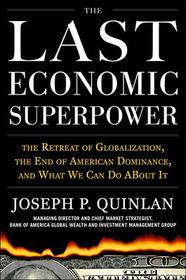
The Last Economic Superpower: The Retreat of Globalization, the End of American Dominance, and What We Can Do About It
The Fall of Globalization and the End of American Dominance
Series: BUSINESS BOOKS;
- Publisher's listprice GBP 37.99
-
17 152 Ft (16 335 Ft + 5% VAT)
The price is estimated because at the time of ordering we do not know what conversion rates will apply to HUF / product currency when the book arrives. In case HUF is weaker, the price increases slightly, in case HUF is stronger, the price goes lower slightly.
- Discount 10% (cc. 1 715 Ft off)
- Discounted price 15 437 Ft (14 702 Ft + 5% VAT)
Subcribe now and take benefit of a favourable price.
Subscribe
17 152 Ft

Availability
Estimated delivery time: In stock at the publisher, but not at Prospero's office. Delivery time approx. 3-5 weeks.
Not in stock at Prospero.
Why don't you give exact delivery time?
Delivery time is estimated on our previous experiences. We give estimations only, because we order from outside Hungary, and the delivery time mainly depends on how quickly the publisher supplies the book. Faster or slower deliveries both happen, but we do our best to supply as quickly as possible.
Product details:
- Publisher McGraw Hill
- Date of Publication 16 December 2010
- ISBN 9780071742832
- Binding Hardback
- No. of pages304 pages
- Size 231x165x25 mm
- Weight 580 g
- Language English 0
Categories
Long description:
The Risks and Rewards for the Westin the Coming Multipolar World
"A marked shift has occurred in the tone and assumptions surrounding our national fortune. Nowhere is this better seen than in the second generation of books dealing with America’s financial crisis, particularly Joseph P. Quinlan’s The Last Economic Superpower."
New York Journal of Books
The global economy, designed by Westernpowers with the United States as lead architect,is in the process of reconfiguration. The2008 global financial crisis has terminatedAmerica’s reign as sole economic superpowerand opened up important new spheres of influenceto developing nations.
Does this signal the retreat of globalizationas we know it? Has an economic “coldwar” already begun? Will the West ever exertthe kind of control and influence it enjoyedjust a few short years ago?
In The Last Economic Superpower, JosephP. Quinlan, a Wall Street veteran and experton global economic affairs, addresses thesequestions and many others. Presenting hisvision with refreshing clarity and objectivity,Quinlan examines:
- How America went from being a majorcreditor to the world’s largest debtor nationin only two decades
- Five critical issues America must face inorder to prevent permanent fragmentation ofthe global economy
- What the fading appeal of Europe andJapan means for the future of globalization
- What China, India, and others havethat the West doesn’t--and why thisgives them unprecedented leverage
Decisions made now will shape the courseof history. The Last Economic Superpoweroutlines critical choices that must be made inorder to recast, reinvent, and reenergize a newstyle of globalization.
The Last Economic Superpower lays barethe issues and challenges that will decidewhether the world builds a new, functionalsystem that serves all or fragments into separatespheres of influence, which benefits noone.
The Risks and Rewards for the Westin the Coming Multipolar World
"A marked shift has occurred in the tone and assumptions surrounding our national fortune. Nowhere is this better seen than in the second generation of books dealing with America’s financial crisis, particularly Joseph P. Quinlan’s The Last Economic Superpower."
New York Journal of Books
The global economy, designed by Westernpowers with the United States as lead architect,is in the process of reconfiguration. The2008 global financial crisis has terminatedAmerica’s reign as sole economic superpowerand opened up important new spheres of influenceto developing nations.
Does this signal the retreat of globalizationas we know it? Has an economic “coldwar” already begun? Will the West ever exertthe kind of control and influence it enjoyedjust a few short years ago?
In The Last Economic Superpower, JosephP. Quinlan, a Wall Street veteran and experton global economic affairs, addresses thesequestions and many others. Presenting hisvision with refreshing clarity and objectivity,Quinlan examines:
- How America went from being a majorcreditor to the world’s largest debtor nationin only two decades
- Five critical issues America must face inorder to prevent permanent fragmentation ofthe global economy
- What the fading appeal of Europe andJapan means for the future of globalization
- What China, India, and others havethat the West doesn’t--and why thisgives them unprecedented leverage
Decisions made now will shape the courseof history. The Last Economic Superpoweroutlines critical choices that must be made inorder to recast, reinvent, and reenergize a newstyle of globalization.
The Last Economic Superpower lays barethe issues and challenges that will decidewhether the world builds a new, functionalsystem that serves all or fragments into separatespheres of influence, which benefits noone.
MoreTable of Contents:
Introduction; Chapter 1. Twenty-five Glorious Years; Chapter 2. The Gathering Storm; Chapter 3. Meltdown and Financial Armageddon; Chapter 4. Speeding Toward a Multi-Polar World; Chapter 5. The "Lost Decade" Leaves a Crippled Giant; Chapter 6. The Twilight in Japan and Europe; Chapter 7. Flexing New Muscles; Chapter 8. The Coming Economic Cold War; Chapter 9. Globalization Reincarnated
More
