

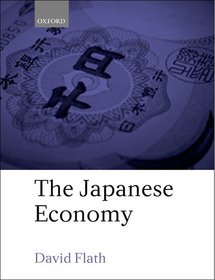
The Japanese Economy
- Publisher's listprice GBP 34.00
-
15 351 Ft (14 620 Ft + 5% VAT)
The price is estimated because at the time of ordering we do not know what conversion rates will apply to HUF / product currency when the book arrives. In case HUF is weaker, the price increases slightly, in case HUF is stronger, the price goes lower slightly.
- Discount 10% (cc. 1 535 Ft off)
- Discounted price 13 816 Ft (13 158 Ft + 5% VAT)
Subcribe now and take benefit of a favourable price.
Subscribe
15 351 Ft

Availability
Out of print
Why don't you give exact delivery time?
Delivery time is estimated on our previous experiences. We give estimations only, because we order from outside Hungary, and the delivery time mainly depends on how quickly the publisher supplies the book. Faster or slower deliveries both happen, but we do our best to supply as quickly as possible.
Product details:
- Publisher Oxford University Press
- Date of Publication 10 February 2000
- ISBN 9780198775034
- Binding Paperback
- No. of pages384 pages
- Size 245x188x20 mm
- Weight 748 g
- Language English
- Illustrations tables 0
Categories
Short description:
Despite recent upheavals, Japan remains one of the dominant economic powers at the end of the twentieth century. Yet the Japanese economy is one of the most misunderstood phenomena in the modern world. Aimed at graduate courses on Japan, this book will be indispensable both for students and instructors alike. Lucid explanations and comprehensive and rigorous analysis make it a natural choice for any interested in comprehending the rise of the Japanese economy.
MoreLong description:
Despite recent upheavals, Japan remains one of the dominant economic powers at the end of the twentieth century. Yet the Japanese economy is one of the most misunderstood phenomena in the modern world. Conventionally, Japan is presented as the exception to mainstream economic theory: an exception to the standard models of modern economics. This book demolishes that notion, bringing the full analytical power of economic thought to all aspects of the most dramatic economic success
story in recent times.
David Flath concentrates on four main themes:
Japan's economic growth and development
Japan's integration with the world economy
Government policies and their effects
Economic institutions and practices
By applying common economic tools such as the Solow growth model, Modigliani's life-cycle model of saving, Becker's theory of investment, Samuelson's theory of revealed preference, Coase's exposition of the problem of social cost, and the modern theory of industrial organization, this book shows the mainstream principles of economics apply in Japan as successfully as they do elsewhere.
Aimed at 3rd/4th year undergraduate and graduate courses on Japan, this book will be indispensable both for students and instructors alike. Lucid explanations and comprehensive and rigorous analysis make it a natural choice for any interested in comprehending the rise of the Japanese economy.
Table of Contents:
Incomes and Welfare of the Japanese Today
Economic History Part 1, The Tokugawa Period, 1603-1868, and the Meiji Era, 1868-1912
Economic History Part 2, The Twentieth Century, 1912-1945
Economic History Part 3, Postwar Recovery, 1945-1964
Saving
Macroeconomics
International Finance
International Trade
Industrial Policy
Public Finance
Environmental Strategy
Industrial Organization
Finance
Marketing
Labor
Technology

