

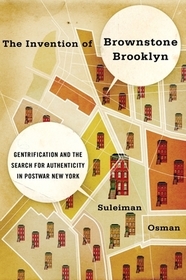
The Invention of Brownstone Brooklyn
Gentrification and the Search for Authenticity in Postwar New York
- Publisher's listprice GBP 35.99
-
16 249 Ft (15 475 Ft + 5% VAT)
The price is estimated because at the time of ordering we do not know what conversion rates will apply to HUF / product currency when the book arrives. In case HUF is weaker, the price increases slightly, in case HUF is stronger, the price goes lower slightly.
- Discount 10% (cc. 1 625 Ft off)
- Discounted price 14 624 Ft (13 928 Ft + 5% VAT)
Subcribe now and take benefit of a favourable price.
Subscribe
16 249 Ft

Availability
printed on demand
Why don't you give exact delivery time?
Delivery time is estimated on our previous experiences. We give estimations only, because we order from outside Hungary, and the delivery time mainly depends on how quickly the publisher supplies the book. Faster or slower deliveries both happen, but we do our best to supply as quickly as possible.
Product details:
- Publisher OUP USA
- Date of Publication 29 November 2012
- ISBN 9780199930340
- Binding Paperback
- No. of pages360 pages
- Size 234x155x27 mm
- Weight 476 g
- Language English
- Illustrations 24 halftones 0
Categories
Short description:
An original and captivating history of gentrification, this book challenges the conventional wisdom that New York City began a comeback in the 1990s, locating the roots of Brooklyn's revival in the social upheavals of the 1960s and 1970s. Osman examines the emergence of a progressive coalition as young, well-educated brownstoners joined with poorer residents to battle city planners and local machine politicians. Deftly mixing architectural, cultural, and political history, this book offers an eye-opening perspective on the post-industrial city.
MoreLong description:
The gentrification of Brooklyn has been one of the most striking developments in recent urban history. Considered one of the city's most notorious industrial slums in the 1940s and 1950s, Brownstone Brooklyn by the 1980s had become a post-industrial landscape of hip bars, yoga studios, and beautifully renovated, wildly expensive townhouses.
In The Invention of Brownstone Brooklyn, Suleiman Osman offers a groundbreaking history of this unexpected transformation. Challenging the conventional wisdom that New York City's renaissance started in the 1990s, Osman locates the origins of gentrification in Brooklyn in the cultural upheavals of the 1960s and 1970s. Gentrification began as a grassroots movement led by young and idealistic white college graduates searching for "authenticity" and life outside the burgeoning suburbs. Where postwar city leaders championed slum clearance and modern architecture, "brownstoners" (as they called themselves) fought for a new romantic urban ideal that celebrated historic buildings, industrial lofts and traditional ethnic neighborhoods as a refuge from an increasingly technocratic society. Osman examines the emergence of a "slow-growth" progressive coalition as brownstoners joined with poorer residents to battle city planners and local machine politicians. But as brownstoners migrated into poorer areas, race and class tensions emerged, and by the 1980s, as newspapers parodied yuppies and anti-gentrification activists marched through increasingly expensive neighborhoods, brownstoners debated whether their search for authenticity had been a success or failure.
The Invention of Brownstone Brooklyn deftly mixes architectural, cultural and political history in this eye-opening perspective on the post-industrial city.
[Osman] has told the story with great insight and drama through an eclectic and well-selected set of historical sources and a felicitous writerly prose.
Table of Contents:
Introduction
Ch 1. Urban Wilderness
Ch 2. Concord Village
Ch 3. The Middle Cityscape
Ch 4. The Two Machines in the Garden
Ch 5. The Highway in the Garden
Ch 6. Inventing Brownstone Brooklyn
Ch 7. The Neighborhood Movement
Conclusion: Brownstone Brooklyn Invented
Notes
Bibliography
Index

