

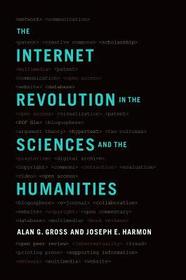
The Internet Revolution in the Sciences and Humanities
- Publisher's listprice GBP 125.00
-
56 437 Ft (53 750 Ft + 5% VAT)
The price is estimated because at the time of ordering we do not know what conversion rates will apply to HUF / product currency when the book arrives. In case HUF is weaker, the price increases slightly, in case HUF is stronger, the price goes lower slightly.
- Discount 10% (cc. 5 643 Ft off)
- Discounted price 50 794 Ft (48 375 Ft + 5% VAT)
Subcribe now and take benefit of a favourable price.
Subscribe
56 437 Ft

Availability
printed on demand
Why don't you give exact delivery time?
Delivery time is estimated on our previous experiences. We give estimations only, because we order from outside Hungary, and the delivery time mainly depends on how quickly the publisher supplies the book. Faster or slower deliveries both happen, but we do our best to supply as quickly as possible.
Product details:
- Publisher OUP USA
- Date of Publication 23 June 2016
- ISBN 9780190465926
- Binding Hardback
- No. of pages272 pages
- Size 159x241x25 mm
- Weight 590 g
- Language English 0
Categories
Short description:
In The Internet Revolution in the Sciences and Humanities, Alan G. Gross and Joseph E. Harmon capture and analyze the work of a small army of innovative scholars and scientists, all of whom have exploited the opportunities the Internet affords, to share with colleagues claims to new knowledge with stronger arguments supported by firmer evidence.
MoreLong description:
The Internet Revolution in the Sciences and Humanities takes a new look at C.P. Snow's distinction between the two cultures, a distinction that provides the driving force for a book that contends that the Internet revolution has sown the seeds for transformative changes in both the sciences and the humanities. It is because of this common situation that the humanities can learn from the sciences, as well as the sciences from the humanities, in matters central to both: generating, evaluating, and communicating knowledge on the Internet. In a succession of chapters, the authors deal with the state of the art in web-based journal articles and books, web sites, peer review, and post-publication review. In the final chapter, they address the obstacles the academy and scientific organizations face in taking full advantage of the Internet: outmoded tenure and promotion procedures, the cost of open access, and restrictive patent and copyright law. They also argue that overcoming these obstacles does not require revolutionary institutional change. In their view, change must be incremental, making use of the powers and prerogatives scientific and academic organizations already have.
MoreTable of Contents:
Chapter 1: The Internet and the Two Cultures
Ideal Types
The Scientific Culture and Scientist as Ideal Type
The Humanistic Culture and Humanist as Ideal Type
The Sciences and Humanities Transformed
The Book Itself
The Audience
Chapter 2: The Scientific Article: What's New
Revolution or Evolution?
A Survey of the Web Article
Increasing Accessibility
The Changing Nature of Authorship
Coping with Complexity
Increasing Inter- and Intra-textuality
Including Reader Comments and Reader Statistics
Enhancing Visualization
Internet Visualization and the Science of Shape
Birth of a Science of Shape
The Mathematical Visualization of Shape
Science of Shape and the Internet
Conclusion
Chapter 3: The Internet Humanities Essay: Seeing and Hearing Anew
Historians See Anew
Photographs as Historical Evidence
Art as Historical Evidence
Reinterpreting the Civil War: The Role of Visualization
Meeting the Challenge of Urban History: A Multi-Media Los Angeles
Re-imagining the Roman Forum: Vision as Hypothesis
Musicians See and Hear Anew
Film Scholars See Anew
Conclusion
Chapter 4: Archival Web Sites in the Humanities and Sciences
Web Sites That Provide Resources for Scholarship
Web Sites That Store Data for Scientific Research
Web Sites That Store Scientific or Scholarly Papers
Web Sites That Create Knowledge Through Volunteer Participation
Web Sites That Codify Existing Knowledge
Conclusion
Chapter 5: Evaluation before Publication: Opening up Peer Review
The Case for and against Peer Review
Argument Theory and Peer Review
Theory Application
Open Internet Peer Review in the Sciences
Open Internet Peer Review in the Humanities
Peer Sourcing: The Wave of the Future?
Conclusion
Chapter 6: Evaluation after Publication: Setting the Record Straight
Science Blogs
What Science Blogs Reveal
How Science Blogs Work
Humanities Post-Peer Review
Post-Publication Peer Review: The Article
Post-Publication Peer Review: The Book
Conclusion
Chapter 7: Overcoming the Obstacles to Internet Exploitation
The Opportunities
Gated Access: The First Obstacle
Current Tenure Rules: The Second Obstacle
Digital Preservation: The Third Obstacle
Patents and Copyright: The Fourth Obstacle
Freedom of Information: The Fifth Obstacle
A Path Forward

