

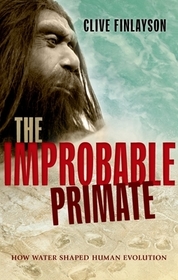
The Improbable Primate
How Water Shaped Human Evolution
- Publisher's listprice GBP 21.99
-
9 928 Ft (9 455 Ft + 5% VAT)
The price is estimated because at the time of ordering we do not know what conversion rates will apply to HUF / product currency when the book arrives. In case HUF is weaker, the price increases slightly, in case HUF is stronger, the price goes lower slightly.
- Discount 10% (cc. 993 Ft off)
- Discounted price 8 935 Ft (8 510 Ft + 5% VAT)
Subcribe now and take benefit of a favourable price.
Subscribe
9 928 Ft

Availability
printed on demand
Why don't you give exact delivery time?
Delivery time is estimated on our previous experiences. We give estimations only, because we order from outside Hungary, and the delivery time mainly depends on how quickly the publisher supplies the book. Faster or slower deliveries both happen, but we do our best to supply as quickly as possible.
Product details:
- Publisher OUP Oxford
- Date of Publication 27 March 2014
- ISBN 9780199658794
- Binding Hardback
- No. of pages232 pages
- Size 224x148x20 mm
- Weight 376 g
- Language English
- Illustrations Approx. 13 black and white illustrations 0
Categories
Short description:
In this provocative view of human evolution, Clive Finlayson argues that the critical factor to shape us was environmental change, particularly the availability of water. Using these new insights he demonstrates the radical implications for our understanding of the emergence and spread of Homo sapiens.
MoreLong description:
In this fresh and provocative view of a seven-million-year evolutionary journey, Finlayson demonstrates the radical implications for the interpretation of fossils and technologies and shows that understanding humans within an ecological context provides insights into the emergence and spread of Homo sapiens worldwide. Finlayson argues that environmental change, particularly availability of water, played a critical role in shaping the direction of human evolution, contributing to our spread and success. He argues that our ancestors carved a niche for themselves by leaving the forest and forcing their way into a long-established community of carnivores in a tropical savannah as climate changes opened up the landscape. They took their chance at high noon, when most other predators were asleep. Adapting to this new lifestyle by shedding their hair and developing an active sweating system to keep cool, being close to fresh water was vital. As the climate dried, our ancestors, already bipedal, became taller and slimmer, more adept at travelling farther in search of water. The challenges of seeking water in a drying landscape moulded the minds and bodies of early humans, and directed their migrations and eventual settlements.
Did water make people human? Mr Finlayson certainly makes a convincing case.
Table of Contents:
Preface
The Inverted Panda
And the World Changed Forever
At the Lake's Edge
The first humans
Middle Earth: The home of the first humans
The Drying World of the Middle Pleistocene
The Rain Chasers - Solutions in a Drying World
The Exceptional World of the Neanderthal
Global Expansion of the Rain Chasers
Nature's Driving Force
Australia
From Lake Chad to Puritjarra and beyond
The Improbable Primate Revisited

