

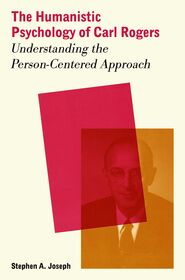
The Humanistic Psychology of Carl Rogers
Understanding the Person-Centered Approach
- Publisher's listprice GBP 32.99
-
14 894 Ft (14 185 Ft + 5% VAT)
The price is estimated because at the time of ordering we do not know what conversion rates will apply to HUF / product currency when the book arrives. In case HUF is weaker, the price increases slightly, in case HUF is stronger, the price goes lower slightly.
- Discount 10% (cc. 1 489 Ft off)
- Discounted price 13 405 Ft (12 767 Ft + 5% VAT)
Subcribe now and take benefit of a favourable price.
Subscribe
14 894 Ft

Availability
Estimated delivery time: In stock at the publisher, but not at Prospero's office. Delivery time approx. 3-5 weeks.
Not in stock at Prospero.
Why don't you give exact delivery time?
Delivery time is estimated on our previous experiences. We give estimations only, because we order from outside Hungary, and the delivery time mainly depends on how quickly the publisher supplies the book. Faster or slower deliveries both happen, but we do our best to supply as quickly as possible.
Product details:
- Publisher OUP USA
- Date of Publication 30 September 2025
- ISBN 9780197790601
- Binding Paperback
- No. of pages260 pages
- Size 232x160x19 mm
- Weight 336 g
- Language English 625
Categories
Short description:
This book presents a holistic overview of the work of renowned psychologist Carl Rogers, known for developing the person-centered approach. It positions Rogers' humanistic approach clearly within contemporary psychology and details its continuing applications in the wider field of human flourishing. In doing so, Stephen A. Joseph offers a critical perspective but ultimately a peaceful synergy between Rogers' person-centered approach and the field of positive psychology. The book provides a comprehensive view on why Rogers' theory matters, the challenges in embracing it, and how to live the person-centered approach in practice.
MoreLong description:
Carl Rogers, one of the most influential psychologists of all time, was a pioneer of humanistic psychology and the originator of the person-centered approach. The person-centered approach is characterized by a trust in people to find their own directions in life when they are in the right social environment: one that is genuine, empathic, and unconditionally accepting. Rogers called it a 'quiet revolution,' realizing that what he had developed was a way of being in the world and with other people that challenged hierarchical structures of power and control. He sparked a revolution in practice that is still relevant today.
Despite Rogers' legacy, his ideas are often diluted, misrepresented, and misunderstood. The Humanistic Psychology of Carl Rogers positions Rogers' humanistic approach clearly within contemporary psychology and the wider field of human flourishing. Stephen A. Joseph shows how it is applied to downstream activities such as therapy and coaching, as well as upstream activities such as education and organizational scholarship, and indeed how it can be applied to all human relationships. The book provides a holistic overview of Rogers' approach, acknowledges its subversive and challenging elements, and details what it can look like in practice. Joseph shows that Rogers' theory is not just of historical interest, but that its principles are grounded in current scholarship and increasingly recognized as important to solving the problems of the modern world.
This is a foundational volume about a psychologist with an exceptional reputation, who understood formal professionals whose job description includes the word "helper," such as counselors, psychologists, psychiatrists, social workers, parents, educators, employers, and politicians.
Table of Contents:
List of Figures
List of Boxes
Foreword
Acknowledgments
Author note
Introduction: An idea ahead of its time
The quiet revolution of Carl Rogers: From non-directive therapy to the person-centered approach
There is nothing so practical as a good theory: A theory of therapy, personality, and interpersonal relationships
Three characteristics of the person-centered approach: Social environment, self-determination, and fully functioning
Reconceptualizing psychopathology: Conditions of worth versus breakdown and disorganization
Issues in person-centered practice: One treatment for all cases
Putting the theory into action: A way of being
Building bridges to positive psychology: Applications to psychotherapy, organizations, and education
The paradox of the person-centered approach: Natural science in theory but phenomenological in practice
The facts are friendly: Evidence from psychotherapy research and positive psychology
Looking ahead
Afterword
Further reading
Notes
References
Index

