

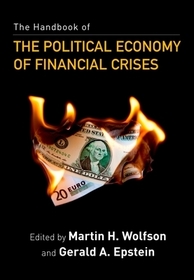
The Handbook of the Political Economy of Financial Crises
- Publisher's listprice GBP 147.50
-
66 596 Ft (63 425 Ft + 5% VAT)
The price is estimated because at the time of ordering we do not know what conversion rates will apply to HUF / product currency when the book arrives. In case HUF is weaker, the price increases slightly, in case HUF is stronger, the price goes lower slightly.
- Discount 10% (cc. 6 660 Ft off)
- Discounted price 59 937 Ft (57 083 Ft + 5% VAT)
Subcribe now and take benefit of a favourable price.
Subscribe
66 596 Ft

Availability
printed on demand
Why don't you give exact delivery time?
Delivery time is estimated on our previous experiences. We give estimations only, because we order from outside Hungary, and the delivery time mainly depends on how quickly the publisher supplies the book. Faster or slower deliveries both happen, but we do our best to supply as quickly as possible.
Product details:
- Publisher OUP USA
- Date of Publication 21 February 2013
- ISBN 9780199757237
- Binding Hardback
- No. of pages784 pages
- Size 234x156x41 mm
- Weight 1266 g
- Language English 0
Categories
Short description:
The Great Financial Crisis that began in 2007-2008 reminds us with devastating force that financial instability and crises are endemic to capitalist economies. This Handbook describes the theoretical, institutional, and historical factors that can help us understand the forces that create financial crises.
MoreLong description:
The Great Financial Crisis that began in 2007-2008 reminds us with devastating force that financial instability and crises are endemic to capitalist economies that lack powerful and dynamically changing financial regulations that can keep the powerful forces of leverage and credit within sustainable bounds. Economists from Marx to Keynes, and Minsky to Kindleberger have well understood this profoundly important fact, yet the dominant mainstream economics of "rational expectations", "efficient markets" and "laissez-faire" that rationalized widespread financial liberalization and still dominates the economics profession has gotten it, literally, "dead wrong". This Handbook of The Political Economy of Financial Crises describes the theoretical, institutional, and historical factors that can help us understand the forces that create financial crises - with an emphasis on the crisis of 2007- 2008 - and the strengths and weaknesses of varying theoretical perspectives and policy approaches that have tried to comprehend and limit these financial tsunamis.
Many leading critics of the capitalist financial system address the causes of the recent great financial crisis and measures to reform it. They emphasize the political economy of financial problems, with much analysis grounded in the theoretical framework of Marx, Keynes, and more recently Hyman Minsky. In this book, the contributors appear to strongly agree that there have been enormous costs from abandoning this framework in favor of the neoliberal ideals of efficient markets, maximization of shareholder wealth, and inherently stable markets. Recommended. Upper-division undergraduates through professionals.
Table of Contents:
Introduction
1. Gerald A. Epstein and Martin H. Wolfson
PART I: THE GREAT FINANCIAL CRISIS: U.S. DYNAMICS AND EFFECTS
2. The Origins of the U.S. Financial Crisis of 2007: How a House Price Bubble, a Credit Bubble, and Regulatory Failure Caused the Greatest Economic Disaster Since the Great Depression.
Marc Jarsulic
3. Speculation and Asset Bubbles
Dean Baker
4. The Great Recession's Impact on Jobs, Wages, and Incomes
Josh Bivens and Heidi Shierholz
5. Distribution and Crisis: Reviewing Some of the Linkages
Arjun Jayadev
6. Housing Markets and Foreclosures
Rachel Drew and Christian Weller
PART II: THEORETICAL APPROACHES FOR UNDERSTANDING FINANCIAL CRISES
7. The Realism of Assumptions Does Matter: Why Keynes-Minsky Theory Must Replace Efficient Market Theory as the Guide to Financial Regulation Policy
James Crotty
8. Political Economy Approaches to Financial Crisis: Hyman Minsky's Financial Fragility Hypothesis
Jan Kregel
9. An Institutional Theory of Financial Crises
Martin H. Wolfson
10. The Anatomy of Financial and Economic Crisis
Duncan K. Foley
PART III: THE GLOBAL DIMENSIONS OF FINANCIAL CRISES
11. The Economic and Financial Crisis of 2008-2010: The International Dimension
Ajit Singh
12. Global Imbalances and the International Monetary System: Problems and Proposals
Jane D'Arista and Korkut Erturk
13. How the Full Opening of the Capital Account to Highly Liquid and Unstable Financial Markets Led Latin America to Two and a Half Cycles of 'Mania, Panic and Crash'
José Gabriel Palma
14. Financial and Currency Crises in Latin America
Mario Damill, Roberto Frenkel and Martin Rapetti
15. The Asian Financial Crisis, Financial Restructuring and the Problem of Contagion
C. P. Chandrasekhar and Jayati Ghosh
16. Speculation and Sovereign Debt - An Insidious Interaction
Gerald Epstein and Pierre Habbard
17. Whither the Euro? History and Crisis of Europe's Single-Currency Project
Robert Guttmann and Dominique Plihon
18. The Eurozone Crisis through the Prism of World Money
Costas Lapavitsas
PART IV: THE ROLE OF INSTITUTIONAL AND STRUCTURAL CHANGE IN THE DEVELOPMENT OF FINANCIAL CRISES
19. Changes in the Postwar Global Economy
David M. Kotz
20. Bank Lending and the Subprime Crisis
Gary Dymski
21. Deregulation and the New Financial Architecture
Damon Silvers
22. What We Don't Talk About When We Talk About Banking
Jennifer S. Taub
23. Derivatives in the Crisis and Financial Reform
Michael Greenberger
24. From Innovation to Financialization: How Shareholder Value Ideology is Destroying the US Economy
William Lazonick
25. Financialization and the Global Economy
Engelbert Stockhammer
26. The Restructuring of Capitalism in Our Time
William K. Tabb
PART V: POLICY AND INSTITUTIONAL CHANGE TO LIMIT FINANCIAL CRISES
27. International and Regional Cooperation for Dealing with Financial Crises
Jose Antonio Ocampo
28. Productive Incoherence in a Time of Crisis: The IMF and the Resurrection of Capital Controls
Ilene Grabel
29. The Japanese Boom and Bust: "Lean " and "Clean " Lessons
Robert McCauley
30. The Role of the Federal Reserve: Lender of Last Resort
Chris Rude
31. Monetary Policy and Central Banking after the Crisis: The Implications of Rethinking Macroeconomic Theory
Thomas I. Palley
32. The Bailout of the "Too Big to Fail " Banks: Never Again
Fred Moseley
33. The Savings and Loan Crisis and Bailout: Lessons for Policy
Dorene Isenberg
34. Pension Policies to Minimize Future Economic Crises
Teresa Ghilarducci
35. A Minskian Road to Financial Reform
Randall Wray
36. The Global Financial Crisis and Africa: The Effects and Policy Responses
Zuzana Brixiova and Léonce Ndikumana
37. Beyond Capitalism?
Minqi Li

