

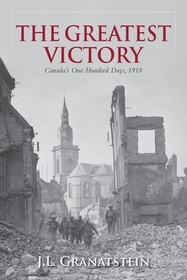
The Greatest Victory
Canada's One Hundred Days, 1918
- Publisher's listprice GBP 20.99
-
9 476 Ft (9 025 Ft + 5% VAT)
The price is estimated because at the time of ordering we do not know what conversion rates will apply to HUF / product currency when the book arrives. In case HUF is weaker, the price increases slightly, in case HUF is stronger, the price goes lower slightly.
- Discount 10% (cc. 948 Ft off)
- Discounted price 8 529 Ft (8 123 Ft + 5% VAT)
Subcribe now and take benefit of a favourable price.
Subscribe
9 476 Ft

Availability
Only to order.
Why don't you give exact delivery time?
Delivery time is estimated on our previous experiences. We give estimations only, because we order from outside Hungary, and the delivery time mainly depends on how quickly the publisher supplies the book. Faster or slower deliveries both happen, but we do our best to supply as quickly as possible.
Product details:
- Publisher OUP Canada
- Date of Publication 24 July 2014
- ISBN 9780199009312
- Binding Hardback
- No. of pages304 pages
- Size 231x162x21 mm
- Weight 412 g
- Language English
- Illustrations 50 b/w figures/8 colour images 0
Categories
Short description:
Award-winning historian J.L. Granatstein here recounts the successful Canadian-led attacks in the final days of World War 1 that took the Allies to victory in November 1918. Canada's participation in this campaign, leading successful and well-coordinated attacks along the Western Front on Amiens, the Drocourt-Quéant line, the Canal du Nord, Valenciennes and Mons was one of the greatest contribution of any nation to the defeat of Imperial Germany. It was also the greatest battle Canada has ever fought. Granatstein's account of these events is gripping and fast-paced, unflinchingly illuminated by often surprising and unexpected detail (Canadians, for example, were among the heaviest users of gas warfare). This remarkably well-written book contains a wealth of both colour and black and white illustrations, including some that have never before been published.
MoreLong description:
The battle of Vimy Ridge in April 1917 is a much celebrated moment in both Canadian and European military history. Vimy was a costly success. While it did improve military and public morale, the reality is that it was more of a symbolic victory than a strategic one (the Germans retreated a few miles and many lives had been lost).
Surprisingly, few Canadians are familiar with the real story of Canadian military success and sacrifice: the Hundred Days that led to the end of the war. Beginning on August 8, 1918, the Canadian Corps launched a series of attacks that took Amiens, crossed the Canal du Nord, smashed the Hindenburg Line, took Cambrai and Valenciennes, and defeated a quarter of the German Army in the field. On the morning of August 8, following the Canadian-led attack, German commander and joint head of the German army Erich Ludendorff called it "the Black Day of the German Army." In the hundred days that preceded the Armistice on November 11, 1918, the Canadian Corps made its greatest contribution to the Allied victory in World War 1 and, without question, the greatest contribution any Canadian force has ever made in battle. The 100,000 soldiers of the four Canadian divisions fought a mobile war that was revolutionary in its effectiveness and, as Jack Granatstein argues, would influence the course of subsequent fighting, particularly in World War 2. With 45,000 casualties in three months (almost a quarter of Canadian casualties during the whole four years of the war), however, the costs were heavy.
These Canadian-led assaults changed Allied fighting from static defensive positions to a war of mobility, technology, and smart coordination. How did Canadians come to lead these mobile, well-coordinated, and hard-hitting attacks? The preparations were intense, according to Granatstein, ranging from individual training to massive corps-wide exercises; careful analysis of "lessons learned" studies; expansion of the role of signallers, gunners and engineers; and perfection of techniques like the "creeping barrage." The "fire and movement" philosophy emphasized by Sir Arthur Currie, Commander of the Canadian Corps, increased the use of tanks, machine guns, Stokes mortars, and phosphorus bombs, among other military hardware. Mobility was the key; Canadians used their two Motor Machine Brigades - with guns and mortars mounted on armoured cars and trucks - with great effect.
Granatstein is an award-winning historian who has received six honorary degrees for his work on conflict and Canadian history. He is a gifted writer with a profound understanding of the historical and political context of World War I, as well as the many factors that played into the complex events in the final days of the war. These factors include complex politics, the logistics of large-scale battles, the personalities organizing the battles, and even the specific weather and geography that influenced battle outcomes. Perhaps most important is Granatstein's excellent selection of soldiers' own description of their experience on the ground, in his use of the Canadian Letters and Images Project. In addition to these perspectives, events are recounted from a variety of angles, including that of Canada's most famous General, Sir Arthur Currie.
This new account of Canada's one hundred days will displace Vimy as the moment to remember about how the Great War was won - with difficulty, determination, and sacrifice.
Table of Contents:
Introduction
Amiens, August 8, 1918
Canada and the War
Breaking the Drocourt-Quéant Line
Crossing the Canal du Nord and Taking Cambrai
Valenciennes and Mons
To Germany and Home
Appendices
Sources
Acknowledgements

