

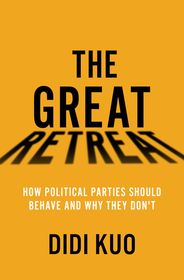
The Great Retreat
How Political Parties Should Behave and Why They Don't
- Publisher's listprice GBP 23.99
-
10 831 Ft (10 315 Ft + 5% VAT)
The price is estimated because at the time of ordering we do not know what conversion rates will apply to HUF / product currency when the book arrives. In case HUF is weaker, the price increases slightly, in case HUF is stronger, the price goes lower slightly.
- Discount 10% (cc. 1 083 Ft off)
- Discounted price 9 748 Ft (9 284 Ft + 5% VAT)
Subcribe now and take benefit of a favourable price.
Subscribe
10 831 Ft

Availability
Estimated delivery time: In stock at the publisher, but not at Prospero's office. Delivery time approx. 3-5 weeks.
Not in stock at Prospero.
Why don't you give exact delivery time?
Delivery time is estimated on our previous experiences. We give estimations only, because we order from outside Hungary, and the delivery time mainly depends on how quickly the publisher supplies the book. Faster or slower deliveries both happen, but we do our best to supply as quickly as possible.
Product details:
- Publisher OUP USA
- Date of Publication 22 May 2025
- ISBN 9780197664193
- Binding Hardback
- No. of pages224 pages
- Size 236x165x23 mm
- Weight 458 g
- Language English 589
Categories
Short description:
In The Great Retreat, Didi Kuo connects the erosion of political parties in advanced democracies to the recent crises of democratic capitalism, focusing on how today's weak parties have ceded governance to the private sector. For democracy to adapt to a new era of global capitalism, Kuo makes the case that we need strong intermediaries like mass parties, socially embedded institutions with deep connections to communities and citizens. As trust in political parties has plummeted, with party membership reaching historic lows, The Great Retreat provides a powerful defense of political parties--for without parties, democratic representation is impossible.
MoreLong description:
As the crisis of democratic capitalism sweeps the globe, The Great Retreat makes the controversial argument that what democracies require most are stronger political parties that serve as intermediaries between citizens and governments.
Once a centralizing force of the democratic process, political parties have eroded over the past fifty years. Parties now rank among the most unpopular institutions in society--less trusted than business, the police, and the media. Identification with parties has plummeted, and even those who are loyal to a party report feeling that parties care more about special interests than about regular citizens. What does a "good" political party look like? Why do we urgently need them? And how do we get them?
The Great Retreat explores the development of political parties as democracy expanded across the West in the nineteenth century. It focuses in particular on mass parties, and the ways they served as intermediaries that fostered ties between citizens and governments. While parties have become professionalized and nationalized, they have lost the robust organizational density that made them effective representatives. After the Cold War, a neoliberal economic consensus, changes to campaign finance, and shifting party priorities weakened the party systems of Western democracies. As Didi Kuo argues, this erosion of political parties has contributed to the recent crisis of democratic capitalism, as weak parties have ceded governance to the private sector.
For democracy to adapt to a new era of global capitalism, Kuo makes the case that we need strong intermediaries like mass parties--socially embedded institutions with deep connections to communities and citizens. Parties are essential to long-term democratic stability and economic growth, while the breakdown of party systems, on the other hand, has historically led to democratic collapse. As trust in political parties has plummeted, The Great Retreat provides a powerful defense of political parties--for without parties, democratic representation is impossible.
Whether we like it or not, political parties are a necessary component of democracy. If you want to know why this is the case-what functions parties should perform in a democracy and what happens when they stop doing so-The Great Retreat is a must read. This book will help you understand the problems facing political parties and our democracy today as well as what needs to be done to make both work better.
Table of Contents:
Chapter 1: Parties and the Crisis of Democracy and Capitalism
Chapter 2: How Did Parties Begin?
Chapter 3: How Did Parties Abandon Us?
Chapter 4: How Did Parties Abandon Politics?
Chapter 5: How Did Parties Get Rich?
Chapter 6: How Did Parties Abandon the Government?
Conclusion: Parties and the Future of Democracy

