

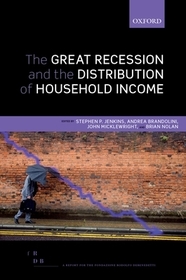
The Great Recession and the Distribution of Household Income
Series: Fondazione Rodolfo Debendetti Reports;
- Publisher's listprice GBP 140.00
-
63 210 Ft (60 200 Ft + 5% VAT)
The price is estimated because at the time of ordering we do not know what conversion rates will apply to HUF / product currency when the book arrives. In case HUF is weaker, the price increases slightly, in case HUF is stronger, the price goes lower slightly.
- Discount 10% (cc. 6 321 Ft off)
- Discounted price 56 889 Ft (54 180 Ft + 5% VAT)
Subcribe now and take benefit of a favourable price.
Subscribe
63 210 Ft

Availability
printed on demand
Why don't you give exact delivery time?
Delivery time is estimated on our previous experiences. We give estimations only, because we order from outside Hungary, and the delivery time mainly depends on how quickly the publisher supplies the book. Faster or slower deliveries both happen, but we do our best to supply as quickly as possible.
Product details:
- Publisher OUP Oxford
- Date of Publication 20 December 2012
- ISBN 9780199671021
- Binding Hardback
- No. of pages296 pages
- Size 241x162x23 mm
- Weight 602 g
- Language English
- Illustrations 68 Figures, 37 Tables 0
Categories
Short description:
The so-called Great Recession that followed the global financial crisis at the end of 2007 was the largest economic downturn since the 1930s for most rich countries. To what extent were household incomes affected by this event, and how did the effects differ across countries? This book is the first study to address these questions.
MoreLong description:
The so-called Great Recession that followed the global financial crisis at the end of 2007 was the largest economic downturn since the 1930s for most rich countries. To what extent were household incomes affected by this event, and how did the effects differ across countries?
This is the first cross-national study of the impact of the Great Recession on the distribution of household incomes. Looking at real income levels, poverty rates, and income inequality, it focusses on the period 2007-9, but also considers longer-term impacts. Three vital contributions are made. First, the book reviews lessons from the past about the relationships between macroeconomic change and the household income distribution. Second, it considers the experience of 21 rich OECD member countries drawing on a mixture of national accounts, and labour force and household survey data. Third, the book presents case-study evidence for six countries: Germany, Ireland, Italy, Sweden, the UK, and the USA. The book shows that, between 2007 and 2009, government support through the tax and benefit system provided a cushion against the downturn, and household income distributions did not change much. But, after 2009, there is likely to be much greater change in incomes as a result of the fiscal consolidation measures that are being put into place to address the structural deficits accompanying the recession. The book's main policy lesson is that stabilisation of the household income distribution in the face of macroeconomic turbulence is an achievable policy goal, at least in the short-term.
This most timely volume is a valuable addition to economics and development studies collections... Highly recommended.
Table of Contents:
Preface
Scope, review of approaches, and evidence from the past
The Great Recession and its consequences for household incomes in 21 countries
Country case study - Germany
Country case study - Ireland
Country case study - Italy
Country case study - Sweden
Country case study - UK
Country case study - USA
Summary and conclusions

