

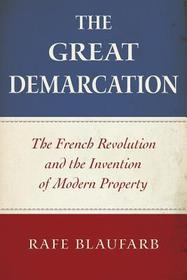
The Great Demarcation
The French Revolution and the Invention of Modern Property
- Publisher's listprice GBP 34.49
-
16 477 Ft (15 692 Ft + 5% VAT)
The price is estimated because at the time of ordering we do not know what conversion rates will apply to HUF / product currency when the book arrives. In case HUF is weaker, the price increases slightly, in case HUF is stronger, the price goes lower slightly.
- Discount 10% (cc. 1 648 Ft off)
- Discounted price 14 829 Ft (14 123 Ft + 5% VAT)
Subcribe now and take benefit of a favourable price.
Subscribe
16 477 Ft

Availability
printed on demand
Why don't you give exact delivery time?
Delivery time is estimated on our previous experiences. We give estimations only, because we order from outside Hungary, and the delivery time mainly depends on how quickly the publisher supplies the book. Faster or slower deliveries both happen, but we do our best to supply as quickly as possible.
Product details:
- Publisher OUP USA
- Date of Publication 2 May 2019
- ISBN 9780190056520
- Binding Paperback
- No. of pages304 pages
- Size 231x155x17 mm
- Weight 454 g
- Language English 0
Categories
Short description:
This book examines how the French Revolutionaries remade the pre-1789 system of property by removing public power from the sphere of property and excising property from the realm of sovereignty. This created a Great Demarcation between property and power, state and society, political and social, public and private--the conceptual basis of political modernity.
MoreLong description:
What does it mean to own something? What sorts of things can be owned, and what cannot? How does one relinquish ownership? What are the boundaries between private and public property? Over the course of a decade, the French Revolution grappled with these questions. Punctuated by false starts, contingencies, and unexpected results, this process laid the foundations of the Napoleonic Code and modern notions of property.
As Rafe Blaufarb demonstrates in this ambitious work, the French Revolution remade the system of property-holding that had existed in France before 1789. The revolutionary changes aimed at two fundamental goals: the removal of formal public power from the sphere of property and the excision of property from the realm of sovereignty. The revolutionaries accomplished these two aims by abolishing privately-owned forms of power, such as jurisdictional lordship and venal public office, and by dismantling the Crown domain, thus making the state purely sovereign. This brought about a Great Demarcation: a radical distinction between property and power from which flowed the critical distinctions between the political and the social, state and society, sovereignty and ownership, the public and private. It destroyed the conceptual basis of the Old Regime, laid the foundation of France's new constitutional order, and crystallized modern ways of thinking about polities and societies.
By tracing how the French Revolution created a new legal and institutional reality, The Great Demarcation shows how the revolutionary transformation of Old Regime property helped inaugurate political modernity
Deeply original....The book's elegant argument proposes a simultaneous birth of a modern state and a modern property regime.
Table of Contents:
Acknowledgments
Note on the Use of French Technical Vocabulary
Introduction
Chapter 1 Talking Property before 1789
Chapter 2 Loyseau's Legacy: The Night of August 4th and the First Abolition of Feudalism
Chapter 3 The Death and Rebirth of the Direct Domain: The Second Feudal Abolition
Chapter 4 The Invention of the National Domain
Chapter 5 Emptying the Domain: The Problem of Engagements
Chapter 6 When the Nation Became a Lord: Feudal Dues as Biens Nationaux
Epilogue
Glossary
Notes
Bibliography
Index

