

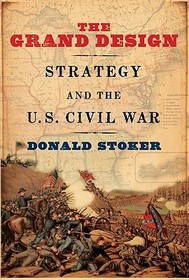
The Grand Design
Strategy and the U.S. Civil War
- Publisher's listprice GBP 26.49
-
11 960 Ft (11 390 Ft + 5% VAT)
The price is estimated because at the time of ordering we do not know what conversion rates will apply to HUF / product currency when the book arrives. In case HUF is weaker, the price increases slightly, in case HUF is stronger, the price goes lower slightly.
- Discount 10% (cc. 1 196 Ft off)
- Discounted price 10 764 Ft (10 251 Ft + 5% VAT)
Subcribe now and take benefit of a favourable price.
Subscribe
11 960 Ft

Availability
printed on demand
Why don't you give exact delivery time?
Delivery time is estimated on our previous experiences. We give estimations only, because we order from outside Hungary, and the delivery time mainly depends on how quickly the publisher supplies the book. Faster or slower deliveries both happen, but we do our best to supply as quickly as possible.
Product details:
- Publisher OUP USA
- Date of Publication 5 August 2010
- ISBN 9780195373059
- Binding Hardback
- No. of pages512 pages
- Size 163x236x40 mm
- Weight 839 g
- Language English 0
Categories
Short description:
In The Grand Design, Donald Stoker reveals the evolution of military strategy on both sides of the Mason-Dixon line
MoreLong description:
Of the tens of thousands of books exploring virtually every aspect of the Civil War, surprisingly little has been said about what was in fact the determining factor in the outcome of the conflict: differences in Union and Southern strategy.
In The Grand Design, Donald Stoker provides a comprehensive and often surprising account of strategy as it evolved between Fort Sumter and Appomattox. Reminding us that strategy is different from tactics (battlefield deployments) and operations (campaigns conducted in pursuit of a strategy), Stoker examines how Abraham Lincoln and Jefferson Davis identified their political goals and worked with their generals to craft the military means to achieve them--or how they often failed to do so. Stoker shows that Davis, despite a West Point education and experience as Secretary of War, failed as a strategist by losing control of the political side of the war. His invasion of Kentucky was a turning point that shifted the loyalties and vast resources of the border states to the Union. Lincoln, in contrast, evolved a clear strategic vision, but he failed for years to make his generals implement it. At the level of generalship, Stoker notes that Robert E. Lee correctly determined the Union's center of gravity, but proved mistaken in his assessment of how to destroy it. Stoker also presents evidence that the Union could have won the war in 1862, had it followed the grand plan of the much-derided general, George B. McClellan.
Historians have often argued that the North's advantages in population and industry ensured certain victory. In The Grand Design, Stoker reasserts the centrality of the overarching military ideas--the strategy--on each side, arguing convincingly that it was strategy that determined the war's outcome.
The Grand Design is an excellent military study of the Civil War. It is well researched and written. It flows smoothly and keeps the reader's interest. It is critical of both sides ... and Stoker is not afraid to offer controversial interpretations.

