

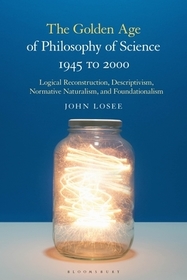
The Golden Age of Philosophy of Science 1945 to 2000
Logical Reconstructionism, Descriptivism, Normative Naturalism, and Foundationalism
-
GET 18% OFF
- Publisher's listprice GBP 33.99
-
16 238 Ft (15 465 Ft + 5% VAT)
The price is estimated because at the time of ordering we do not know what conversion rates will apply to HUF / product currency when the book arrives. In case HUF is weaker, the price increases slightly, in case HUF is stronger, the price goes lower slightly.
- Discount 18% (cc. 2 923 Ft off)
- Discounted price 13 315 Ft (12 681 Ft + 5% VAT)
- Discount is valid until: 31 May 2026
13 315 Ft

Availability
printed on demand
Why don't you give exact delivery time?
Delivery time is estimated on our previous experiences. We give estimations only, because we order from outside Hungary, and the delivery time mainly depends on how quickly the publisher supplies the book. Faster or slower deliveries both happen, but we do our best to supply as quickly as possible.
Product details:
- Publisher Bloomsbury Publishing (UK)
- Date of Publication 25 June 2020
- Number of Volumes Paperback
- ISBN 9781350169135
- Binding Paperback
- No. of pages328 pages
- Size 234x156 mm
- Weight 458 g
- Language English 23
Categories
Long description:
This book offers the reader a guide to the major philosophical approaches to science since World War Two. Considering the bases, arguments and conclusions of the four main movements - Logical Reconstructionism, Descriptivism, Normative Naturalism and Foundationalism - John Losee explores how philosophy has both shaped and expanded our understanding of science.
The volume features major figures of twentieth century science, and engages with the work of previous philosophers of science, including Norman Campbell, Rudolf Carnap, Ernest Nagel, Karl Popper, Richard Dawkins, and John Worrall. In particular, The Golden Age of Philosophy of Science, 1945 to 2000 aims to answer the following questions: How should competing philosophies of science be evaluated? Should philosophy of science be a prescriptive discipline? Can philosophy of science achieve normative status without designating trans-historical evaluative principles? And finally, how can understanding the history of science aid us in analyzing the philosophy of science? In answering these questions, this book shows us why we understand science the way we do.
The Golden Age of Philosophy of Science 1945 to 2000 is essential reading for students and researchers working in the history and philosophy of science.
Table of Contents:
1. Logical Reconstructionism
2. Orthodoxy under attack
3. Interlude: A Classificatory Matrix
4. Descriptivism
5. Normative Naturalism
6. Foundationalism
7. Descriptivism versus Foundationalism
Index of Names
Index of Subjects

