

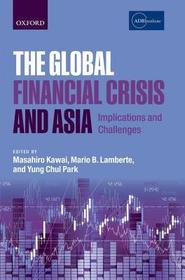
The Global Financial Crisis and Asia
Implications and Challenges
- Publisher's listprice GBP 102.50
-
48 969 Ft (46 637 Ft + 5% VAT)
The price is estimated because at the time of ordering we do not know what conversion rates will apply to HUF / product currency when the book arrives. In case HUF is weaker, the price increases slightly, in case HUF is stronger, the price goes lower slightly.
- Discount 10% (cc. 4 897 Ft off)
- Discounted price 44 072 Ft (41 973 Ft + 5% VAT)
Subcribe now and take benefit of a favourable price.
Subscribe
48 969 Ft

Availability
printed on demand
Why don't you give exact delivery time?
Delivery time is estimated on our previous experiences. We give estimations only, because we order from outside Hungary, and the delivery time mainly depends on how quickly the publisher supplies the book. Faster or slower deliveries both happen, but we do our best to supply as quickly as possible.
Product details:
- Publisher OUP Oxford
- Date of Publication 25 October 2012
- ISBN 9780199660957
- Binding Hardback
- No. of pages344 pages
- Size 241x162x24 mm
- Weight 694 g
- Language English
- Illustrations 86 Figures, 20 Tables 0
Categories
Short description:
This book demonstrates how Asian countries tried to minimize the impact of the global financial crisis, identifies structural weaknesses in their economies, and discusses policy options for strengthening Asian economies to avoid future crises and promote sustainable growth in the long-term.
MoreLong description:
This book aims to identify and analyze the impact of the 2007-09 global financial crisis on Asian economies and to assess the short-term and longer-term policy responses to the crisis in terms of their effectiveness and sustainability. It draws lessons on how best to avoid and/or mitigate future crises and to identify structural policy recommendations that can help guide Asian policymakers to expand the growth potential of domestic and regional demand in coming years, and thereby create a basis for sustainable and inclusive long-term growth.
Organized into four parts, it offers an accessible explanation of the causes, consequences, and contagion mechanisms of the crisis. Part 1 provides an overview of the major issues and presents policy recommendations. Part 2 reviews the crisis in the US and its transmission to Europe. Part 3 focuses on the impact on Asia. And Part 4 concludes lessons of the crisis for Asian countries. The volume highlights that Asian economies have already recovered strongly from the global financial crisis, reflecting their aggressive moves to ease monetary and fiscal policy as well as the underlying fundamental strength of their economies. However, the biggest challenge lies ahead. It asserts that, given that it is unlikely that the US and Europe will be engines of global growth, Asian economies should contribute to global economic adjustment by creating their own growth engines.
Table of Contents:
Preface
Part 1: Overview
Introduction and Overview
Part 2: Crisis in the US and Transmission to Europe
America's Financial Crisis: the End of an Era
The Eurozone in the Global Financial Crisis
Part 3: Impacts of the Global Financial Crisis on Asia
Recession and Recoveries in Asia: What Can the Past Teach Us about the Present
Intra-Regional Trade in East Asia: The Decoupling Fallacy, Crisis and Policy Challenges
Decoupling of East Asia: Myth or Reality?
The Global Financial Crisis: Impact on the Chinese Economy, Policy Responses and Rebalancing Approach
The Global Economic Crisis: Impact on India and Policy Responses
The Republic of Korea's Economy in the Swirl of Global Crisis
Thailand's Growth Rebalancing
Malaysia and the Global crisis: Impact, response, and rebalancing strategies
Part 4: Lessons and Emerging Issues in Asia
Lessons of the Crisis for Emerging Markets
Growth Patterns in Asian Emerging Markets: Implication for Global Rebalancing
International Reserves and Swap Lines in Times of Financial Distress

