

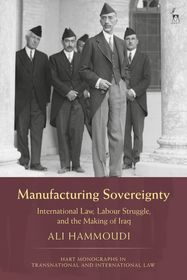
Manufacturing Sovereignty
International Law, Labour Struggle, and the Making of Iraq
Series: Hart Monographs in Transnational and International Law;
- Publisher's listprice GBP 90.00
-
42 997 Ft (40 950 Ft + 5% VAT)
The price is estimated because at the time of ordering we do not know what conversion rates will apply to HUF / product currency when the book arrives. In case HUF is weaker, the price increases slightly, in case HUF is stronger, the price goes lower slightly.
- Discount 13% (cc. 5 590 Ft off)
- Discounted price 37 408 Ft (35 627 Ft + 5% VAT)
Subcribe now and take benefit of a favourable price.
Subscribe
42 997 Ft

Availability
Not yet published.
Why don't you give exact delivery time?
Delivery time is estimated on our previous experiences. We give estimations only, because we order from outside Hungary, and the delivery time mainly depends on how quickly the publisher supplies the book. Faster or slower deliveries both happen, but we do our best to supply as quickly as possible.
Product details:
- Publisher Bloomsbury Publishing (UK)
- Date of Publication 19 February 2026
- Number of Volumes Hardback
- ISBN 9781509952878
- Binding Hardback
- No. of pages304 pages
- Size 234x156 mm
- Language English 700
Categories
Short description:
A unique analysis of international law and employment law to show how an international doctrine can shape labour practices in an emerging nation state.
MoreLong description:
This book delves into the legal and labour history of the Hashemite Kingdom of Iraq to explore the role international law and its institutions played in Iraq's state formation.
Focusing on a turbulent period in global and Middle East history, it shows how the case of Iraq became a laboratory for experimentation with the concept of sovereignty by the Permanent Mandates Commission of the League of Nations in Geneva. This resulted in the development of a doctrine of 'semiperipheral sovereignty' to justify Iraq's independence from the Mandate process. This novel doctrine and its operation within the provisions of the 1930 Anglo- Iraq Treaty ensured the maintenance of British dominance over Iraq, especially to safeguard the extraction and transportation of its valuable oil resources to Western markets.
The book traces how this legal doctrine impacted the everyday lives of working class Iraqis. It explores the governance of the extraterritorial spaces of capitalist accumulation and labour exploitation, in particular the Iraq Petroleum Company oil fi elds, the Iraq State Railways and the Port of Basra. It goes on to detail how the oil, railway and port workers led by the Iraqi Communist Party effectively organised themselves into a nationalist revolutionary labour movement. They waged an anti-colonial struggle against these imperial legal structures to improve their lot, leading up to the 1948 Wathba, the 1953 Intifada, and ultimately the July Revolution of 1958, which upended the British-sponsored monarchy.
Spanning various international archives and Arabic primary source materials, this book offers an example of a social, legal and labour history written from below, centering ordinary working peoples' agency in the historiography of international law. Drawing on Third World Approaches to International Law (TWAIL) and Marxist methodologies, it emphasises the signifi cance of the semi-periphery in the making of the international legal order.
Table of Contents:
Introduction
1. Enclosing Mesopotamia: Frontier Governmentality, The Rule of Property and the Origins of Underdevelopment in Hashemite Iraq
2. Manufacturing Iraqi (Semi-peripheral) Sovereignty in Geneva: Dominance Through De Jure 'Independence'
3. Civilizing Labour Relations in Baghdad: The ILO and the Making of the Iraqi Working Class
4. Disrupting the Circuits of Capitalism: The IPC Workers' Struggle against the Legal Infrastructures of the Oil Frontier of the Middle East
5. Forging Independent Labour Unions: The Railway and Port Workers' Struggles against the Arteries of Imperial Communications and Trade
6. Permanent Emergency and the Criminialisation of Dissent as Technologies of Semi-Colonial Governance
7. The Defeat of the Portsmouth Treaty: al-Wathba and its Contribution to the Conjuncture of Decolonisation in International Law
Conclusion

