

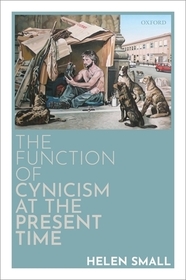
The Function of Cynicism at the Present Time
- Publisher's listprice GBP 39.99
-
19 105 Ft (18 195 Ft + 5% VAT)
The price is estimated because at the time of ordering we do not know what conversion rates will apply to HUF / product currency when the book arrives. In case HUF is weaker, the price increases slightly, in case HUF is stronger, the price goes lower slightly.
- Discount 10% (cc. 1 911 Ft off)
- Discounted price 17 194 Ft (16 376 Ft + 5% VAT)
Subcribe now and take benefit of a favourable price.
Subscribe
19 105 Ft

Availability
Estimated delivery time: Expected time of arrival: end of January 2026.
Not in stock at Prospero.
Why don't you give exact delivery time?
Delivery time is estimated on our previous experiences. We give estimations only, because we order from outside Hungary, and the delivery time mainly depends on how quickly the publisher supplies the book. Faster or slower deliveries both happen, but we do our best to supply as quickly as possible.
Product details:
- Publisher OUP Oxford
- Date of Publication 29 June 2020
- ISBN 9780198861935
- Binding Hardback
- No. of pages282 pages
- Size 238x163x23 mm
- Weight 590 g
- Language English
- Illustrations 2 Illustrations 74
Categories
Short description:
Tracing and re-evaluating the role of cynicism within literature, public moralism, and critical philosophy, this volume discovers how a range of modern writers have engaged with Cynic traditions of thought to test the boundaries of what can be thought and said on matters of general moral concern.
MoreLong description:
Cynicism is usually seen as a provocative mode of dissent from conventional moral thought, casting doubt on the motives that guide right conduct. When critics today complain that it is ubiquitous but lacks the serious bite of classical Cynicism, they express concern that it can now only be corrosively negative. The Function of Cynicism at the Present Time takes a more balanced view. Re-evaluating the role of cynicism in literature, cultural criticism, and philosophy from 1840 to the present, it treats cynic confrontationalism as a widely-employed credibility-check on the promotion of moral ideals--with roots in human psychology.
Helen Small investigates how writers have engaged with Cynic traditions of thought, and later more gestural styles of cynicism, to re-calibrate dominant moral values, judgements of taste, and political agreements. The argument develops through a series of cynic challenges to accepted moral thinking: Friedrich Nietzsche on morality; Thomas Carlyle v. J. S. Mill on the permissible limits of moral provocation; Arnold on the freedom of criticism; George Eliot and Ford Madox Ford on cosmopolitanism; Bertrand Russell, John Dewey, and Laura Kipnis on the conditions of work in the university. The Function of Cynicism treats topics of present-day public concern: abrasive styles of public argument; debasing challenges to conventional morality; free speech, moral controversialism; the authority of reason and the limits of that authority; nationalism and resistance to nationalism; and liberty of expression as a core principle of the university.
Adeptly employing classic thought to evaluate modern works, Small presents strategies that will prompt thoughtful discussion and could also veer into nihilism. Adroitly moving between ancient and modern ethics, this insightful volume will interest a broad audience. Summing Up: Highly recommended. Lower-division undergraduates through faculty; general readers.
Table of Contents:
Introduction: The Function of Cynicism
On Nietzsche and Doing Less with Cynicism
Speech beyond Toleration: Moral Controversialism Then and Now (Mill v. Carlyle)
The Freedom of Criticism: Arnold's Cynicisms
Cosmopolitan Cynicisms: George Eliot and Ford Madox Ford
In Praise of Idleness? Cynicism and the Humanities (Bertrand Russell, John Dewey, Laura Kipnis)
Coda: Last and First Things

