

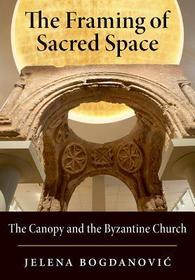
The Framing of Sacred Space
The Canopy and the Byzantine Church
- Publisher's listprice GBP 72.00
-
34 398 Ft (32 760 Ft + 5% VAT)
The price is estimated because at the time of ordering we do not know what conversion rates will apply to HUF / product currency when the book arrives. In case HUF is weaker, the price increases slightly, in case HUF is stronger, the price goes lower slightly.
- Discount 10% (cc. 3 440 Ft off)
- Discounted price 30 958 Ft (29 484 Ft + 5% VAT)
Subcribe now and take benefit of a favourable price.
Subscribe
34 398 Ft

Availability
printed on demand
Why don't you give exact delivery time?
Delivery time is estimated on our previous experiences. We give estimations only, because we order from outside Hungary, and the delivery time mainly depends on how quickly the publisher supplies the book. Faster or slower deliveries both happen, but we do our best to supply as quickly as possible.
Product details:
- Publisher OUP USA
- Date of Publication 24 August 2017
- ISBN 9780190465186
- Binding Hardback
- No. of pages452 pages
- Size 257x178x33 mm
- Weight 1293 g
- Language English
- Illustrations 141 color and 44 black-and-white illustrations 0
Categories
Short description:
As architectonic objects of basic structural and design integrity, canopies provide means for an innovative understanding of the materialization of the idea of the Byzantine-rite church. The Framing of Sacred Space considers both the material and conceptual framing of sacred space and explains how the canopy bridges the physical and transcendental realms.
MoreLong description:
The Framing of Sacred Space offers the first topical study of canopies as essential spatial and symbolic units in Byzantine-rite churches. Centrally planned columnar structures--typically comprised of four columns and a roof--canopies had a critical role in the modular processes of church design, from actual church furnishings in the shape of a canopy to the church's structural core. As architectonic objects of basic structural and design integrity, canopies integrate an archetypical image of architecture and provide means for an innovative understanding of the materialization of the idea of the Byzantine church and its multi-focal spatial presence.
The Framing of Sacred Space considers both the material and conceptual framing of sacred space and explains how the canopy bridges the physical and transcendental realms. As a crucial element of church design in the Byzantine world, a world that gradually abandoned the basilica as a typical building of Roman imperial secular architecture, the canopy carried tectonic and theological meanings and, through vaulted, canopied bays and recognizable Byzantine domed churches, established organic architectural, symbolic, and sacred ties between the Old and New Covenants. In such an overarching context, the canopy becomes an architectural parti, a vital concept and dynamic design principle that carries the essence of the Byzantine church. The Framing of Sacred Space highlights significant factors in understanding canopies through specific architectural settings and the Byzantine concepts of space, thus also contributing to larger debates about the creation of sacred space and related architectural taxonomy.
For the first time a thorough investigation examines the symbolism, cultural and religious value, and fortune of the canopy as a basic element of church architecture in Byzantium and related cultures (300-1500)...This book, which receives an elegant treatment from Oxford University Press, is furnished with rare illustrations and a number of charts and drawings that clarify the author's points and provide the nonexpert reader with precious help. Indeed, this is an invaluable scholarly contribution that helps us to understand the complexity of thoughts and beliefs behind what may appear to be a small architectural element, the canopy.
Table of Contents:
Acknowledgements
Notes on sources, translations, and illustrations
List of abbreviations
List of tables
List of illustrations
Maps
Introduction
Chapter 1: Ciborium or Canopy? Textual Evidence on Canopies in the Byzantine Church
Chapter 2: Canopies in the Byzantine Church: Archaeological and Architectural Evidence
Chapter 3: Place-Making: The Place of the Canopy within the Church
Chapter 4: The Micro-Architectural Framing of Sacred Space
Chapter 5: Nested in its Own Shape: The Canopy and the Byzantine Church
Conclusions
Appendices
Tables
Bibliography
Index

