

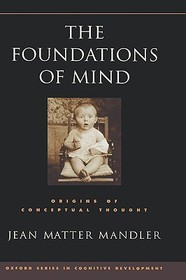
The Foundations of Mind
Origins of Conceptual Thought
Series: Oxford Series in Cognitive Development;
- Publisher's listprice GBP 62.00
-
27 993 Ft (26 660 Ft + 5% VAT)
The price is estimated because at the time of ordering we do not know what conversion rates will apply to HUF / product currency when the book arrives. In case HUF is weaker, the price increases slightly, in case HUF is stronger, the price goes lower slightly.
- Discount 10% (cc. 2 799 Ft off)
- Discounted price 25 194 Ft (23 994 Ft + 5% VAT)
Subcribe now and take benefit of a favourable price.
Subscribe
27 993 Ft

Availability
printed on demand
Why don't you give exact delivery time?
Delivery time is estimated on our previous experiences. We give estimations only, because we order from outside Hungary, and the delivery time mainly depends on how quickly the publisher supplies the book. Faster or slower deliveries both happen, but we do our best to supply as quickly as possible.
Product details:
- Publisher OUP USA
- Date of Publication 20 May 2004
- ISBN 9780195172003
- Binding Hardback
- No. of pages376 pages
- Size 243x156x23 mm
- Weight 658 g
- Language English
- Illustrations 5 halftones, numerous line drawings 0
Categories
Short description:
This book offers a theory of how human conceptual life begins, and shows how perceptual information becomes transformed into concepts. Drawing on extensive research, Mandler describes the development of preverbal concept formation, inductive inference, and recall, and explains how these processes form the conceptual basis for language and adult thought.
MoreLong description:
The Foundations of Mind presents a new theory of cognitive development in infancy, focusing on the ways that perceptual information becomes transformed into conceptual thought. Mandler tackles issues such as how babies form concepts and begin to think before they have language, and how they can recall the past and make inductive inferences. Drawing on her extensive research, she illustrates how these processes form the conceptual basis for language and advanced thought, stressing the importance of distinguishing automatic perceptual processes from conceptualizations about what is perceived. She argues that these two kinds of learning, though sometimes confounded in psychological experimentation, follow different principles, and that it is crucial to specify the particular kind of learning required by a given task. Early preverbal concepts, although typically more general than infant perceptual categories, allow infants to make the inductive generalizations necessary for them to form theories about the world and organize their developing conceptual system into a recognizably adult form.
Mandler also addresses the neglected issues of how concepts such as animacy, inanimacy, agency, goal, containment, and support are represented in the mind. She suggests that image-schemas, used by cognitive linguists to represent underlying linguistic meanings, also format the basic concepts used by infants for inferential thought and language learning. She also shows how a mechanism that analyzes spatial displays leads to mini-theories about how various objects interact with one another.
Countering strong nativist and empiricist views, Mandler provides a fresh and markedly different perspective on early cognitive development, painting a new picture of the abilities and accomplishments of infants and the development of the mind.
Table of Contents:
How to Build a Baby: Prologue
Piaget's Sensorimotor Infant
Kinds of Representation: Seeing and Thinking
Perceptual Meaning Analysis and Image-Schemas: The Infant as Interpreter
Some Image-Schemas and their Functions
Some Differences between Percepts and Concepts: The Case of the Basic Level
Some Preverbal Concepts
Conceptual Categories as Induction Machines
Continuity in the Conceptual System: Acquisition, Breakdown and Reorganization
Recall of the Past
Language Acquisition
Consciousness and Conclusions

