

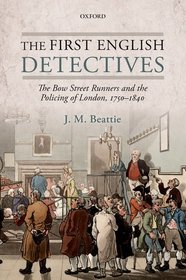
The First English Detectives
The Bow Street Runners and the Policing of London, 1750-1840
- Publisher's listprice GBP 49.99
-
22 570 Ft (21 495 Ft + 5% VAT)
The price is estimated because at the time of ordering we do not know what conversion rates will apply to HUF / product currency when the book arrives. In case HUF is weaker, the price increases slightly, in case HUF is stronger, the price goes lower slightly.
- Discount 10% (cc. 2 257 Ft off)
- Discounted price 20 313 Ft (19 346 Ft + 5% VAT)
Subcribe now and take benefit of a favourable price.
Subscribe
22 570 Ft

Availability
printed on demand
Why don't you give exact delivery time?
Delivery time is estimated on our previous experiences. We give estimations only, because we order from outside Hungary, and the delivery time mainly depends on how quickly the publisher supplies the book. Faster or slower deliveries both happen, but we do our best to supply as quickly as possible.
Product details:
- Publisher OUP Oxford
- Date of Publication 6 February 2014
- ISBN 9780199675388
- Binding Paperback
- No. of pages288 pages
- Size 236x157x16 mm
- Weight 418 g
- Language English 0
Categories
Short description:
This is the first comprehensive study of the Bow Street Runners, a group of men established in the middle of the eighteenth century by Henry Fielding to confront violent offenders on the streets and highways around London.
MoreLong description:
This is the first comprehensive study of the Bow Street Runners, a group of men established in the middle of the eighteenth century by Henry Fielding, with the financial support of the government, to confront violent offenders on the streets and highways around London. They were developed over the following decades by his half-brother, John Fielding, into what became a well-known and stable group of officers who acquired skill and expertise in investigating crime, tracking and arresting offenders, and in presenting evidence at the Old Bailey, the main criminal court in London. They were, Beattie argues, detectives in all but name. Fielding also created a magistrates' court that was open to the public, at stated times every day.
A second, intimately-related theme in the book concerns attitudes and ideas about the policing of London more broadly, particularly from the 1780s, when the detective and prosecutorial work of the runners came to be challenged by arguments in favour of the prevention of crime by surveillance and other means. The last three chapters of the book continue to follow the runners' work, but at the same time are concerned with discussions of the larger structure of policing in London - in parliament, in the Home Office, and in the press. These discussions were to intensify after 1815, in the face of a sharp increase in criminal prosecutions. They led - in a far from straightforward way - to a fundamental reconstitution of the basis of policing in the capital by Robert Peel's Metropolitan Police Act of 1829. The runners were not immediately affected by the creation of the New Police, but indirectly it led to their disbandment a decade later.
... the foremost historian of crime, the law and policing in Hanoverian London, brings his formidable knowledge and astute perception to tracing the history of the Bow Street police ... a short review cannot do justice to the research and shrewd judgements that underlie this lively volume ... anyone interested in the history of crime and policing in England cannot afford to ignore it.
Table of Contents:
Introduction
Henry Fielding at Bow Street
John Fielding and the making of the Bow Street Runners
Detection: the Runners at Work, 1765-1792
Prosecution: the runners in court, 1765-1792
Fielding's Legacy: police reform in the 1780s
The Runners in a New Age of Policing, 1792-1815
Prevention: the Runners in Retreat, 1815-1839
Epilogue
Bibliography

