

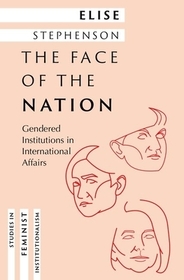
The Face of the Nation
Gendered Institutions in International Affairs
Series: Studies in Feminist Institutionalism;
- Publisher's listprice GBP 66.00
-
29 799 Ft (28 380 Ft + 5% VAT)
The price is estimated because at the time of ordering we do not know what conversion rates will apply to HUF / product currency when the book arrives. In case HUF is weaker, the price increases slightly, in case HUF is stronger, the price goes lower slightly.
- Discount 10% (cc. 2 980 Ft off)
- Discounted price 26 819 Ft (25 542 Ft + 5% VAT)
Subcribe now and take benefit of a favourable price.
Subscribe
29 799 Ft

Availability
Estimated delivery time: In stock at the publisher, but not at Prospero's office. Delivery time approx. 3-5 weeks.
Not in stock at Prospero.
Why don't you give exact delivery time?
Delivery time is estimated on our previous experiences. We give estimations only, because we order from outside Hungary, and the delivery time mainly depends on how quickly the publisher supplies the book. Faster or slower deliveries both happen, but we do our best to supply as quickly as possible.
Product details:
- Publisher OUP USA
- Date of Publication 22 March 2024
- ISBN 9780197632727
- Binding Hardback
- No. of pages304 pages
- Size 163x226x43 mm
- Weight 567 g
- Language English 472
Categories
Short description:
The Face of the Nation studies women's leadership and gender relations across some of the worst performing and most male-dominated spheres of state--international affairs. Exploring the stories from almost 80 global women leaders, as well as institutional histories and policies across diplomacy, defense, national security, policing, and intelligence, this book seeks to understand why women remain under-represented on the global stage, despite many changing social and policy norms. Using Australia as a leading case study, the book extends theories on gender and international institutions to understand the gendered, racialized, and heteronormative structures that continue to limit and impact on diverse women's leadership and participation internationally.
MoreLong description:
Foreign services globally are undergoing fundamental and rapid gendered change, spurred on by shifting social and governance norms and even the adoption of an explicit feminist foreign policy in some stages. For some, this has resulted in women's rapidly increasing representation at the frontlines of global governance. Yet, compounded by COVID-19, a rise in right-wing misogyny and extremism, and sometimes archaically slow-moving institutions, progress is marred by women's continued, entrenched under-representation in leadership and devastating challenges that have increased in recent years. Women remain frequently side-lined, marginalized, under-valued, and overlooked in international affairs. In short, international affairs has a gender problem, and remains one of the worst-performing sectors of the state.
After studying women's leadership and gender relations across four international affairs agencies spanning diplomacy, defense, national security, policing, and intelligence, The Face of the Nation contributes empirical data from the last 30+ years on women's representation in a leading case context--Australia--to understand the disconnect between pockets of progress and undercurrents of resistance. Australia is a global leader in terms of representation of women and policy supports for gender equality in governance. Yet, Australia also demonstrates how deeply gendered, racialized, and heteronormative international institutions remain. Through in-depth interviews with almost 80 global leaders, including with Australia's first female prime minister, Julia Gillard, and first female foreign minister, Julie Bishop, this book delivers a much-needed Intersectional Feminist Institutionalist approach to trace the evolution of inequalities in international affairs and interrogate why women still remain under-represented in international affairs.
Elise Stephenson's forensic examination of the challenges faced by women in international affairs is eye-opening and a call to action to address the gendered barriers to leadership in diplomacy.
Table of Contents:
Dedication
Foreword
Chapter One: Where are the Women?
Chapter Two: Exploring Theories on Gender and International Affairs
Chapter Three: Who I Researched and How I Did It
Chapter Four: Historical Developments in International Affairs and Deep Insights into the Case Agencies
Chapter Five: Which Women Lead International Affairs?
Chapter Six: Where are the Women in International Affairs Leadership?
Chapter Seven: How Did You Get There? Career Paths and Leadership
Chapter Eight: Why do Women Remain Under-Represented (and Unequal) in International Affairs?
Conclusion: How Inequality Evolves in International Institutions

