

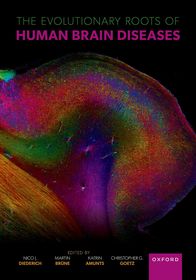
The Evolutionary Roots of Human Brain Diseases
- Publisher's listprice GBP 137.50
-
62 081 Ft (59 125 Ft + 5% VAT)
The price is estimated because at the time of ordering we do not know what conversion rates will apply to HUF / product currency when the book arrives. In case HUF is weaker, the price increases slightly, in case HUF is stronger, the price goes lower slightly.
- Discount 10% (cc. 6 208 Ft off)
- Discounted price 55 873 Ft (53 213 Ft + 5% VAT)
Subcribe now and take benefit of a favourable price.
Subscribe
62 081 Ft

Availability
Estimated delivery time: In stock at the publisher, but not at Prospero's office. Delivery time approx. 3-5 weeks.
Not in stock at Prospero.
Why don't you give exact delivery time?
Delivery time is estimated on our previous experiences. We give estimations only, because we order from outside Hungary, and the delivery time mainly depends on how quickly the publisher supplies the book. Faster or slower deliveries both happen, but we do our best to supply as quickly as possible.
Product details:
- Publisher OUP USA
- Date of Publication 24 December 2024
- ISBN 9780197676592
- Binding Hardback
- No. of pages576 pages
- Size 256x185x29 mm
- Weight 1379 g
- Language English 548
Categories
Short description:
The Evolutionary Roots of Human Brain Diseases assembles recent findings in clinical neuroscience, evolutionary biology, anthropology, and cellular biology to elucidate the origins of human brain diseases and how evolution has given rise to exclusive impacts on brain health only in humans. The book is succinct, up-to-date, and written by researchers across numerous disciplines, making it a compulsory read for clinical neurologists, psychologists, and all medical researchers interested in the brain.
MoreLong description:
Richly illustrated with figures and examples and supplemented with a glossary of terms, The Evolutionary Roots of Human Brain Diseases assembles recent findings in clinical neuroscience, evolutionary biology, anthropology, and cellular biology to elucidate the origins of human brain diseases and how evolution has given rise to exclusive impacts on brain health only in humans. The book is succinct, up-to-date, and written by researchers across numerous disciplines, making it a compulsory read for clinical neurologists, psychologists, and all medical researchers interested in the brain.
The book's 22 chapters cover basic science concepts behind cerebral cellular specificities or human-specific network developments, detailed discussions of neurological or psychiatric diseases and their clinical expression with an evolutionary focus, the newest imaging techniques to study the brain, future medication developments, as well as cultural and societal repercussions. Evolutionary concepts ranging from genetic pleiotropic antagonism to disease remnants of ancient behaviours crucial for survival are also presented. Insightful and innovative in its approach, this book offers a fascinating interdisciplinary dialogue on the potential repercussions of ongoing human brain evolution.
Table of Contents:
Foreword by Sten Grillner
Introduction by the Editors, Nico J. Diederich, Martin Brüne, Katrin Amunts, Christopher G. Goetz
Part I: Human Brain Evolution: From Anatomy to Function
Chapter 1: Human Telencephalization
Katrin Amunts and Felix Ströckens
Chapter 2: Evolutionary Aspects of Glial Expansion
Pierre Magistretti, Patrick Hof , Corrado Cali, and Nicole Ackermans
Chapter 3: The Contribution of Mitochondrial Evolution and Dysfunction to Neurodegeneration
Anne Grünewald, Sandro Pereira, and Kobi Wasner
Chapter 4: Intrinsic Templates for Neurodegenerations Featuring Disease-specific Axonal or Dendritic Vulnerability
Toshiki Uchihara
Chapter 5: Differences in Brain Gene Expression Between Humans and Primates
Geneviève Konopka and Emre Caglayan
Chapter 6: Adapative Archaic Introgression
Olga Dolgova and Oscar Lao
Chapter 7: Goal-directed and Habitual Behaviors: Anatomical and Functional Circuits in Health and Neurological Disease
Ledia F. Hernandez and Ignacio Obeso
Part II: How Human Brain Diseases Are Impacted By Human Evolution
Chapter 8: Alzheimer's Disease, the Parietal Lobes, and the Evolution of the Human Genus
Emiliano Bruner and Heidi I.L. Jacobs
Chapter 9: Parkinson's Disease - Overstrain Focused of Basal Ganglia and Brainstem Nuclei
Nico J. Diederich and Christopher G. Goetz
Chapter 10: Brain Diseases Associated with Unstable Repeats
Peng Jin, Katharine Shelly, and Emily G. Allen
Chapter 11: The Properties of Cortico-Motoneuronal Connections and Their Evolutionary Significance for Amyotrophic Lateral Sclerosis
Roger Lemon
Chapter 12: REM Sleep Behavior Disorder - Nocturnal Replay of a "Fight and Flee"
Nico Diederich and Isabelle Arnulf
Chapter 13: Mood Disorders: An Evolutionary Psycho-Neuro-Immunological Approach
Markus J Rantala Javier I. Borráz-León
Chapter 14: Schizophrenia - Embracing the Spectrum
John S. Allen
Chapter 15: Williams Syndrome and Autism - Dysfunction of Frontal Networks
Katerina Semendeferi and Isabel August
Chapter 16: ADHD - An Evolutionary View
Annie Swanepoel
Chapter 17: Addiction - Diverted Reward and Motivation Principles
Roger Sullivan and Edward Hagen
Part 3: Consequences and perspectives on research and clinical sciences
Chapter 18: Conditions of Comparative Brain Connectomics
Kathleen Rockland, Daniel Zachlod, and Katrin Amunts
Chapter 19: Are Evolutionary Concepts Helfpul in Designing Preventive Strategies for Brain Diseases?
Gilberto Levy and Bruce Levin
Chapter 20: Evolutionary Aspects of Neuro-Psychopharmocology
Martin Brüne, Riadh Abed, and Paul St. John-Smith
Chapter 21: Ongoing Human Evolution?
Frank Rühli, Maciej Henneberg, and Nicole Bender
Chapter 22: Human Cultural Evolution Outpaces Biological Evolution: A Brain Connectomic Approach
Jean-Pierre Changeux
Chapter 23: Concluding Remarks and Future Directions
Martin Brüne, Katrin Amunts, Nico J. Diederich, and Christopher G. Goetz

