

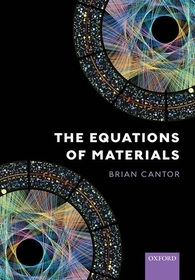
The Equations of Materials
- Publisher's listprice GBP 41.49
-
18 732 Ft (17 840 Ft + 5% VAT)
The price is estimated because at the time of ordering we do not know what conversion rates will apply to HUF / product currency when the book arrives. In case HUF is weaker, the price increases slightly, in case HUF is stronger, the price goes lower slightly.
- Discount 10% (cc. 1 873 Ft off)
- Discounted price 16 859 Ft (16 056 Ft + 5% VAT)
Subcribe now and take benefit of a favourable price.
Subscribe
18 732 Ft

Availability
printed on demand
Why don't you give exact delivery time?
Delivery time is estimated on our previous experiences. We give estimations only, because we order from outside Hungary, and the delivery time mainly depends on how quickly the publisher supplies the book. Faster or slower deliveries both happen, but we do our best to supply as quickly as possible.
Product details:
- Publisher OUP Oxford
- Date of Publication 23 July 2020
- ISBN 9780198851882
- Binding Paperback
- No. of pages336 pages
- Size 247x170x16 mm
- Weight 632 g
- Language English
- Illustrations 113 color line figures and 15 grayscale halftones 23
Categories
Short description:
This book describes some of the important equations of materials and the scientists who derived them. The text is readable and enjoyable, and is aimed at anyone interested in the manufacture, structure, properties and engineering application of materials such as metals, polymers, ceramics, semiconductors and composites.
MoreLong description:
This primer describes important equations of materials and the scientists who derived them. It provides an excellent introduction to the subject by making the material accessible and enjoyable. The book is dedicated to a number of propositions:
1. The most important equations are often simple and easily explained;
2. The most important equations are often experimental, confirmed time and again;
3. The most important equations have been derived by remarkable scientists who lived interesting lives.
Each chapter covers a single equation and materials subject, and is structured in three sections: first, a description of the equation itself; second, a short biography of the scientist after whom it is named; and third, a discussion of some of the ramifications and applications of the equation. The biographical sections intertwine the personal and professional life of the scientist with contemporary political and scientific developments.
Topics included are: Bravais lattices and crystals; Bragg's law and diffraction; the Gibbs phase rule and phases; Boltzmann's equation and thermodynamics; the Arrhenius equation and reactions; the Gibbs-Thomson equation and surfaces; Fick's laws and diffusion; the Scheil equation and solidification; the Avrami equation and phase transformations; Hooke's law and elasticity; the Burgers vector and plasticity; Griffith's equation and fracture; and the Fermi level and electrical properties.
The book is written for students interested in the manufacture, structure, properties and engineering application of materials such as metals, polymers, ceramics, semiconductors and composites. It requires only a working knowledge of school maths, mainly algebra and simple calculus.
A wonderful book ... that does not take more than a couple of weeks to digest. Although students these days do not purchase many books, this particular text might be considered worth owning.
Table of Contents:
Bravais Lattices: Crystals
Bragg's Law: Diffraction
The Gibbs phase rule
The Boltzmann equation: Thermodynamics
The Arrhenius equation: Reactions
The Gibbs-Thomson Equation: Surfaces
Fick's Laws: Diffusion
The Scheil Equation: Solidification
The Avrami Equation: Phase Transformations
Hooke's Law: Elasticity
The Burgers Vector: Plasticity
Griffith's Equation: Fracture
The Fermi Level: Electrical Properties

