

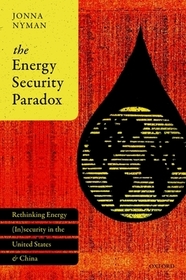
The Energy Security Paradox
Rethinking Energy (In)security in the United States and China
- Publisher's listprice GBP 92.00
-
43 953 Ft (41 860 Ft + 5% VAT)
The price is estimated because at the time of ordering we do not know what conversion rates will apply to HUF / product currency when the book arrives. In case HUF is weaker, the price increases slightly, in case HUF is stronger, the price goes lower slightly.
- Discount 10% (cc. 4 395 Ft off)
- Discounted price 39 558 Ft (37 674 Ft + 5% VAT)
Subcribe now and take benefit of a favourable price.
Subscribe
43 953 Ft

Availability
printed on demand
Why don't you give exact delivery time?
Delivery time is estimated on our previous experiences. We give estimations only, because we order from outside Hungary, and the delivery time mainly depends on how quickly the publisher supplies the book. Faster or slower deliveries both happen, but we do our best to supply as quickly as possible.
Product details:
- Publisher OUP Oxford
- Date of Publication 5 April 2018
- ISBN 9780198820444
- Binding Hardback
- No. of pages192 pages
- Size 243x165x19 mm
- Weight 446 g
- Language English 0
Categories
Short description:
This book tackles a crucial aspect of international politics: the politics of energy security.
MoreLong description:
The decisions we make about energy shape our present and our future. From geopolitical tension to environmental degradation and an increasingly unstable climate, these choices infiltrate the very air we breathe. Energy security politics has direct impact on the continued survival of human life as we know it, and the earth cannot survive if we continue consuming fossil energy at current rates. The low carbon transition is simply not happening fast enough, and change is unlikely without a radical change in how we approach energy security. But thinking on energy security has failed to keep up with these changing realities. Energy security is primarily considered to be about the availability of reliable and affordable energy supplies - having enough energy - and it remains closely linked to national security.
The Energy Security Paradox looks at contemporary energy security politics in the United States and China: the top two energy consumers and producers. Based on in-depth empirical analysis, it demonstrates that current energy security practices actually lead to a security paradox: they produce insecurity. To illustrate this, it develops the 'energy security paradox' as a framework for understanding the interconnected insecurities produced by current practices. However, it also goes beyond this, examining resistance to current practices to highlight that we not only can do energy security differently: this is already happening. In the process, the volume demonstrates that the value of security depends on the context. Based on this, The Energy Security Paradox proposes a radical reconsideration of how we approach and practice energy security.
Table of Contents:
Introducing the Energy Security Paradox
Understanding Energy (In)security
'Common Sense' Energy Security in the United States
Contesting Energy Security in the United States
'Common Sense' Energy Security in China
Contesting Energy Security in China
Conclusion: Re-imagining Energy Security

