

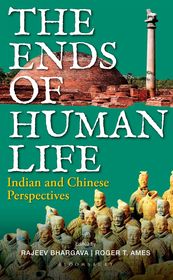
The Ends of Human Life
Indian and Chinese Perspectives
-
GET 18% OFF
- Publisher's listprice GBP 85.00
-
38 377 Ft (36 550 Ft + 5% VAT)
The price is estimated because at the time of ordering we do not know what conversion rates will apply to HUF / product currency when the book arrives. In case HUF is weaker, the price increases slightly, in case HUF is stronger, the price goes lower slightly.
- Discount 18% (cc. 6 908 Ft off)
- Discounted price 31 470 Ft (29 971 Ft + 5% VAT)
- Discount is valid until: 31 August 2026
31 470 Ft

Availability
Not yet published.
Why don't you give exact delivery time?
Delivery time is estimated on our previous experiences. We give estimations only, because we order from outside Hungary, and the delivery time mainly depends on how quickly the publisher supplies the book. Faster or slower deliveries both happen, but we do our best to supply as quickly as possible.
Product details:
- Publisher Bloomsbury Publishing (UK)
- Date of Publication 30 September 2026
- Number of Volumes Hardback
- ISBN 9789361315305
- Binding Hardback
- No. of pages300 pages
- Size 222x144x20 mm
- Weight 480 g
- Language English 700
Categories
Short description:
The collection of essays in this volume explores how the theme of the ends of human life is addressed in selected pre-modern texts from Indian and Chinese traditions of thought.
MoreLong description:
This volume brings into dialogue key texts from early and late Vedic, Early Buddhist, Confucian, and Bhakti traditions, each addressing fundamental questions concerning the aims and conditions of human life. Through a close engagement with these diverse yet philosophically rich traditions, the essays in this collection examine six interrelated questions central to the human quest for meaning, fulfillment, and ethical orientation.
The first concerns the ends of human life: from material prosperity, aesthetic delight, and social recognition to moral rectitude, spiritual devotion, and contemplative knowledge. The volume probes how these ends are articulated, ordered, and interpreted within and across traditions. Are these ends discrete or interdependent? Can they coexist harmoniously, or are they marked by tension and hierarchy-perhaps culminating in a single, highest good?
A third area of inquiry relates to the practices and modes of life required to realize these ends-what virtues must be cultivated, and which vices eschewed? Fourth, the volume interrogates whether these ends are universally accessible or specific to particular social groups or stages of life. Fifth, it explores the implications of dependence, freedom, and social structure in the pursuit of these goods. Lastly, the volume considers the institutional and political arrangements best suited to enable or constrain the realization of diverse life ideals.
By drawing connections between classical sources and contemporary concerns, this interdisciplinary collection offers both a historically grounded and philosophically nuanced contribution to ongoing reflections on the good life.
Table of Contents:
Acknowledgements
Introduction
Rajeev Bhargava
1 Fame, Ambition and Selflessness in Indian Moral Discourse
Patrick Olivelle
2 Confucian Way-Making (dao ?) and the Trivarga: A
Rationalizing of 'the Ends of Life' or the Aesthetic of
Exemplary Lives Lived?
Roger T. Ames
3 The Sequential Problem of the Eight Human Aims in the
Great Learning
Chenyang Li
4 The Fifth Puru?artha: Bhakti as The End of Life
Sudipta Kaviraj
5 Puru?arthas and the Art of Human Seeking
Rakesh Pandey
6 Dialogue and Dharma in the Mahabharata: The Case of
Draupadi-'s Marriage
Brian Black
7 Dharma in Transition and a Disenchanted World: The
Mahabharata, Ni?kama Karman, and An?sa?sya
Kanad Sinha
8 Understanding Kama in an Early Upanishadic Dialogue
Ananya Vajpeyi
9 Riders in the Chariot: Self-cultivation as a Means for
Attaining Happiness, Heaven and Nirva?a in Early Buddhism
Jens Schlieter
10 The Great Good of Relationship and Its Troubles
David B. Wong
11 Unveiling of Consciousness - Kavya as a Vehicle of Puru?artha
Radhavallabh Tripathi
References
About the Editors and Contributors
Index

