

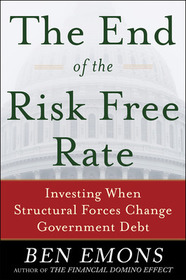
The End of the Risk-Free Rate: Investing When Structural Forces Change Government Debt
Investing When Structural Forces Change Government Debt
Series: PROFESSIONAL FINANCE & INVESTM;
- Publisher's listprice GBP 54.99
-
24 827 Ft (23 645 Ft + 5% VAT)
The price is estimated because at the time of ordering we do not know what conversion rates will apply to HUF / product currency when the book arrives. In case HUF is weaker, the price increases slightly, in case HUF is stronger, the price goes lower slightly.
- Discount 10% (cc. 2 482 Ft off)
- Discounted price 22 345 Ft (21 281 Ft + 5% VAT)
Subcribe now and take benefit of a favourable price.
Subscribe
24 827 Ft

Availability
printed on demand
Why don't you give exact delivery time?
Delivery time is estimated on our previous experiences. We give estimations only, because we order from outside Hungary, and the delivery time mainly depends on how quickly the publisher supplies the book. Faster or slower deliveries both happen, but we do our best to supply as quickly as possible.
Product details:
- Publisher McGraw Hill
- Date of Publication 16 July 2013
- ISBN 9780071819527
- Binding Hardback
- No. of pages256 pages
- Size 236x157x22 mm
- Weight 513 g
- Language English 0
Categories
Long description:
A NEW FINANCIAL STRATEGY FOR A NEW FINANCIAL WORLD
As an investor, you've probably taken advantage of the risk-free rates in the postcrash economy by putting your money into bonds, stocks, commodities, and currencies. With the rise of government debt across the globe, you can no longer rely on the notion of "safe" to perform asexpected. You need to adapt your investing strategy to a new financial reality.
Filled with expert tips, this step-by-step guide walks you through all of your investment options, showing you how each will be affected by the end of the risk-freerate. You'll learn:
- What you should know before buying bonds and Treasury bills
- How to recognize and invest in the strongest emerging markets
- How to choose between government and corporate options
- What the debt-to-GDP ratio means for you and your investments
- How to evaluate foreign markets in the rapidly changing global economy
With the author's guidance, you'll discover that you don't need to stop investing in government bonds and otherpopular options--you just need to invest differently. You'll learn about combining liquid means, ETFs, mutual funds, and individual securities. You'll gain insights into market depth, liquidity, and capital flows--and how they change depending on regulations, costs, and other factors. You'll see how the debt situations in countries like Mexico and Italy can have an immediate impact on investors around the world. You’ll find new ways to thinkabout investing in a changing economic landscape. Most importantly, you'll learn how to assess risk in different markets.
An essential guide in these fascinating times, The End of the Risk-Free Rate marks a new beginning for today's investor.
A NEW FINANCIAL STRATEGY FOR A NEW FINANCIAL WORLD
As an investor, you've probably taken advantage of the risk-free rates in the postcrash economy by putting your money into bonds, stocks, commodities, and currencies. With the rise of government debt across the globe, you can no longer rely on the notion of "safe" to perform asexpected. You need to adapt your investing strategy to a new financial reality.
Filled with expert tips, this step-by-step guide walks you through all of your investment options, showing you how each will be affected by the end of the risk-freerate. You'll learn:
- What you should know before buying bonds and Treasury bills
- How to recognize and invest in the strongest emerging markets
- How to choose between government and corporate options
- What the debt-to-GDP ratio means for you and your investments
- How to evaluate foreign markets in the rapidly changing global economy
With the author's guidance, you'll discover that you don't need to stop investing in government bonds and otherpopular options--you just need to invest differently. You'll learn about combining liquid means, ETFs, mutual funds, and individual securities. You'll gain insights into market depth, liquidity, and capital flows--and how they change depending on regulations, costs, and other factors. You'll see how the debt situations in countries like Mexico and Italy can have an immediate impact on investors around the world. You’ll find new ways to thinkabout investing in a changing economic landscape. Most importantly, you'll learn how to assess risk in different markets.
An essential guide in these fascinating times, The End of the Risk-Free Rate marks a new beginning for today's investor.
MoreTable of Contents:
A Prelude: Financial Markets Finance ix
Part I: End of the Risk-Free Rate 1
Chapter 1: The End of the Risk-Free Rate 3
Chapter 2: Puzzles 33
Chapter 3: A Way of Life 61
Part II: Investment Implications 97
Chapter 4: Some Quantifi cation 99
Chapter 5: Where and What to Invest In: The “Alternatives” 135
Chapter 6: Bubble Management 183
References 217
Index 223

