

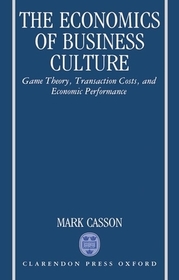
The Economics of Business Culture
Game Theory, Transaction Costs, and Economic Performance
- Publisher's listprice GBP 36.49
-
16 475 Ft (15 690 Ft + 5% VAT)
The price is estimated because at the time of ordering we do not know what conversion rates will apply to HUF / product currency when the book arrives. In case HUF is weaker, the price increases slightly, in case HUF is stronger, the price goes lower slightly.
- Discount 10% (cc. 1 648 Ft off)
- Discounted price 14 827 Ft (14 121 Ft + 5% VAT)
Subcribe now and take benefit of a favourable price.
Subscribe
16 475 Ft

Availability
printed on demand
Why don't you give exact delivery time?
Delivery time is estimated on our previous experiences. We give estimations only, because we order from outside Hungary, and the delivery time mainly depends on how quickly the publisher supplies the book. Faster or slower deliveries both happen, but we do our best to supply as quickly as possible.
Product details:
- Publisher Clarendon Press
- Date of Publication 27 June 1991
- ISBN 9780198283751
- Binding Hardback
- No. of pages298 pages
- Size 225x147x23 mm
- Weight 490 g
- Language English
- Illustrations line drawings, tables 0
Categories
Short description:
Mark Casson, a respected economist, sets out in a rigorous but accessible way, the theory that the culture in which a firm operates has a profound effect on its productivity. One of the topics covered by this book - the role of leadership and manipulation of performance in business culture - is very important and has been largely neglected until now.
MoreLong description:
In this book the author analyses the economic effects of culture. By culture he means social values such as honesty, dedication, and loyalty. He argues that the gains from technology in modern societies can be offset by high cost stemming from the missing moral dimension, and that this has implications both for economic competitiveness and for social and economic institutions such as families and trade unions.
`The questions raised and the methods and conclusion proposed make this a stimulating book, which can usefully be read and digested both by those involved in day to day business leadership, and also by those charged with designing management and business courses for the industrial leaders of the future.'
The Business Economist

