

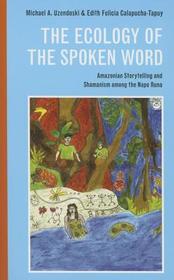
The Ecology of the Spoken Word
Amazonian Storytelling and the Shamanism Among the Napo Runa
- Publisher's listprice GBP 18.99
-
9 072 Ft (8 640 Ft + 5% VAT)
The price is estimated because at the time of ordering we do not know what conversion rates will apply to HUF / product currency when the book arrives. In case HUF is weaker, the price increases slightly, in case HUF is stronger, the price goes lower slightly.
- Discount 10% (cc. 907 Ft off)
- Discounted price 8 165 Ft (7 776 Ft + 5% VAT)
Subcribe now and take benefit of a favourable price.
Subscribe
9 072 Ft

Availability
Temporarily out of stock.
Why don't you give exact delivery time?
Delivery time is estimated on our previous experiences. We give estimations only, because we order from outside Hungary, and the delivery time mainly depends on how quickly the publisher supplies the book. Faster or slower deliveries both happen, but we do our best to supply as quickly as possible.
Product details:
- Edition number 1st Edition
- Publisher University of Illinois Press
- Date of Publication 22 January 2015
- Number of Volumes Paperback
- ISBN 9780252081033
- Binding Paperback
- See also 9780252036569
- No. of pages264 pages
- Size 229x152x28 mm
- Weight 399 g
- Language English
- Illustrations 23 black and white photographs 0
Categories
Long description:
This volume offers the first theoretical and experiential translation of Napo Runa mythology in English. Michael A. Uzendoski and Edith Felicia Calapucha-Tapuy present and analyze lowland Quichua speakers in the Napo province of Ecuador through narratives, songs, curing chants, and other oral performances, so readers may come to understand and appreciate Quichua aesthetic expression. Guiding readers into Quichua ways of thinking and being--in which language itself is only a part of a communicative world that includes plants, animals, and the landscape--Uzendoski and Calapucha-Tapuy weave exacting translations into an interpretive argument with theoretical implications for understanding oral traditions, literacy, new technologies, and language. A companion websiteoffers photos, audio files, and videos of original performances illustrates the beauty and complexity of Amazonian Quichua poetic expressions.

