

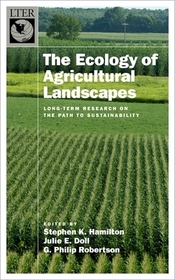
The Ecology of Agricultural Landscapes
Long-Term Research on the Path to Sustainability
Series: The Long-Term Ecological Research Network Series;
- Publisher's listprice GBP 79.00
-
35 668 Ft (33 970 Ft + 5% VAT)
The price is estimated because at the time of ordering we do not know what conversion rates will apply to HUF / product currency when the book arrives. In case HUF is weaker, the price increases slightly, in case HUF is stronger, the price goes lower slightly.
- Discount 10% (cc. 3 566 Ft off)
- Discounted price 32 102 Ft (30 573 Ft + 5% VAT)
Subcribe now and take benefit of a favourable price.
Subscribe
35 668 Ft

Availability
printed on demand
Why don't you give exact delivery time?
Delivery time is estimated on our previous experiences. We give estimations only, because we order from outside Hungary, and the delivery time mainly depends on how quickly the publisher supplies the book. Faster or slower deliveries both happen, but we do our best to supply as quickly as possible.
Product details:
- Publisher OUP USA
- Date of Publication 12 March 2015
- ISBN 9780199773350
- Binding Hardback
- No. of pages448 pages
- Size 160x236x30 mm
- Weight 748 g
- Language English
- Illustrations with 158 illustrations 0
Categories
Short description:
The latest volume in the Long-Term Ecological Research series, presenting two decades of research on the sustainability of temperate, row-crop ecosystems in the Midwestern United States.
MoreLong description:
Evidence has been mounting for some time that intensive row-crop agriculture as practiced in developed countries may not be environmentally sustainable, with concerns increasingly being raised about climate change, implications for water quantity and quality, and soil degradation. This volume synthesizes two decades of research on the sustainability of temperate, row-crop ecosystems of the Midwestern United States. The overarching hypothesis guiding this work has been that more biologically based management practices could greatly reduce negative impacts while maintaining sufficient productivity to meet demands for food, fiber and fuel, but that roadblocks to their adoption persist because we lack a comprehensive understanding of their benefits and drawbacks.
The research behind this book, based at the Kellogg Biological Station (Michigan State University) and conducted under the aegis of the Long-term Ecological Research network, is structured on a foundation of large-scale field experiments that explore alternatives to conventional, chemical-intensive agriculture. Studies have explored the biophysical underpinnings of crop productivity, the interactions of crop ecosystems with the hydrology and biodiversity of the broader landscapes in which they lie, farmers' views about alternative practices, economic valuation of ecosystem services, and global impacts such as greenhouse gas exchanges with the atmosphere. In contrast to most research projects, the long-term design of this research enables identification of slow or delayed processes of change in response to management regimes, and allows examination of responses across a broader range of climatic variability. This volume synthesizes this comprehensive inquiry into the ecology of alternative cropping systems, identifying future steps needed on the path to sustainability.
This compilation of research from the KBS LTER site is significant and could be utilized to inform policy makers and the agricultural industry as well as direct USDA funding. Continuing this research would certainly further advance the understanding of the wide-ranging impacts that arise from agriculture and because agricultural lands comprise over 40% of the Earths land (Owen 2005), the influence could be considerable.
Table of Contents:
Contents
1 Conceptual and Experimental Approaches to Long-term Ecological Research at the Kellogg Biological Station 1
G. Philip Robertson and Stephen K. Hamilton
2 Farming for Ecosystem Services: An Ecological Approach to Production Agriculture 44
G. Philip Robertson, Katherine L. Gross, Stephen K. Hamilton, Douglas A. Landis, Thomas M. Schmidt, Sieglinde S. Snapp, and Scott M. Swinton
3 Economic Value of Ecosystem Services from Agriculture 76
Scott M. Swinton, Christina B. Jolejole-Foreman, Frank Lupi, Shan Ma, Wei Zhang and Huilan Chen
4 A Crop Stress Index to Predict Climatic Effects on Row-crop Agriculture in the U.S. North Central Region 110
Stuart H. Gage, Julie E. Doll, and Gene R. Safir
5 Soil Organic Matter Dynamics: Controls and Management for Sustainable Ecosystem Functioning 142
Eldor A. Paul, Alexandra Kravchenko, A. Stuart Grandy, and Sherri Morris
6 Microbial Diversity in Soils of Agricultural Landscapes and its Relation to Ecosystem Function 186
Thomas M. Schmidt and Clive Waldron
7 Plant Community Dynamics in Agricultural and Successional Fields 216
Katherine L. Gross, Sarah Emery, Adam S. Davis, Richard G. Smith, and Todd M.P. Robinson
8 Arthropod Diversity and Pest Suppression in Agricultural Landscapes 257
Douglas A. Landis and Stuart H. Gage
9 Nitrogen Transfers and Transformations in Row-crop Ecosystems 289
Neville Millar and G. Philip Robertson
10 Simulating Crop Growth and Biogeochemical Fluxes in Response to Land Management using the SALUS Model 343
Bruno Basso and Joe T. Ritchie
11 Water Quality and Movement in Agricultural Landscapes 376
Stephen K. Hamilton
12 Mitigation of Greenhouse Gases in Agricultural Ecosystems 419
Ilya Gelfand and G. Philip Robertson
13 Farmer Decisions about Adopting Environmentally Beneficial Practices 459
Scott M. Swinton, Natalie Rector, G. Philip Robertson, Christina B. Jolejole-Foreman, and Frank Lupi
14 Acoustic Observations in Agricultural Landscapes 490
Stuart H. Gage, Wooyeong Joo, Eric P. Kasten, Jordan Fox, and Subir Biswas
15 Designing Cropping Systems for Ecosystem Services 512
Sieglinde S. Snapp, Richard G. Smith, and G. Philip Robertson

