

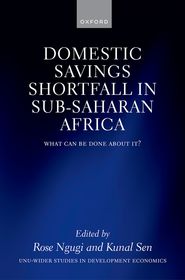
The Domestic Savings Shortfall in Sub-Saharan Africa
What Can Be Done About It?
Series: WIDER Studies in Development Economics;
- Publisher's listprice GBP 99.00
-
44 698 Ft (42 570 Ft + 5% VAT)
The price is estimated because at the time of ordering we do not know what conversion rates will apply to HUF / product currency when the book arrives. In case HUF is weaker, the price increases slightly, in case HUF is stronger, the price goes lower slightly.
- Discount 10% (cc. 4 469 Ft off)
- Discounted price 40 229 Ft (38 313 Ft + 5% VAT)
Subcribe now and take benefit of a favourable price.
Subscribe
44 698 Ft

Availability
Estimated delivery time: In stock at the publisher, but not at Prospero's office. Delivery time approx. 3-5 weeks.
Not in stock at Prospero.
Why don't you give exact delivery time?
Delivery time is estimated on our previous experiences. We give estimations only, because we order from outside Hungary, and the delivery time mainly depends on how quickly the publisher supplies the book. Faster or slower deliveries both happen, but we do our best to supply as quickly as possible.
Product details:
- Publisher OUP Oxford
- Date of Publication 31 May 2025
- ISBN 9780198932482
- Binding Hardback
- No. of pages352 pages
- Size 240x165x25 mm
- Weight 671 g
- Language English 592
Categories
Short description:
Domestic Savings Shortfall in Sub-Saharan Africa aims to increase knowledge about the key drivers of domestic saving rates in Sub-Saharan Africa (SSA), as well as whether alternative approaches, such as pension funds or fintech, could provide new solutions to increase domestic savings.
MoreLong description:
This is an open access title available under the terms of a CC BY-NC-SA 3.0 IGO licence. It is free to read at Oxford Scholarship Online and offered as a free PDF download from OUP and selected open access locations.
Domestic Savings Shortfall in Sub-Saharan Africa aims to increase knowledge about the key drivers of domestic saving rates in Sub-Saharan Africa (SSA), as well as whether alternative approaches, such as pension funds or fintech, could provide new solutions to increase domestic savings. The book also examines the lessons learnt from the experiences so far in different countries in SSA, and what can SSA learn from the experience of other regions which have been more successful in raising savings rates.
The book consists of two parts: thematic studies and country studies. The thematic studies examine the implications of new developments in African financial markets on savings behaviour, the role of sovereign wealth funds, pensions, and capital markets in augmenting savings and in economic development, the challenges of the debt crisis in Africa, the implications of financial liberalization for private saving in SSA, and lessons on how to increase savings rates from East and South Asia. The four country studies-Tanzania, Cameroon, and Ghana-examine the determinants of domestic savings. The countries were selected based on criteria that capture the diversity of savings performance in SSA. Each case study uses a common conceptual framework drawn from the life-cycle theory of savings and the same empirical methods to test for the determinants of savings using time-series data for the country in question. The findings of the book provide clear recommendations on how to increase savings in Sub-Saharan Africa.
Table of Contents:
PART I: INTRODUCTION
The domestic savings shortfall in sub-Saharan Africa: What are the key issues?
PART II: THEMATIC STUDIES
Fintech, savings, and financial inclusion in sub-Saharan Africa
Accelerating capital markets development in sub-Saharan Africa
Old-age savings in sub-Saharan Africa
Sovereign wealth funds in Africa
Public debt challenges in sub-Saharan Africa
The effects of financial liberalization on private savings in sub-Saharan Africa
Economic growth and savings transition in Asia: Unity in diversity
PART III: COUNTRY STUDIES
Drivers of domestic saving in Kenya
Determinants of domestic savings in Tanzania
Understanding domestic savings in sub-Sahara Africa: A case study of Ghana
The determinants of domestic savings in Cameroon
PART IV: CONCLUSION
Conclusions and policy implications

