

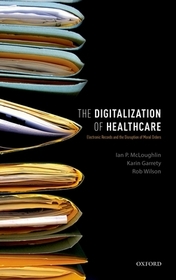
The Digitalization of Healthcare
Electronic Records and the Disruption of Moral Orders
- Publisher's listprice GBP 93.00
-
41 989 Ft (39 990 Ft + 5% VAT)
The price is estimated because at the time of ordering we do not know what conversion rates will apply to HUF / product currency when the book arrives. In case HUF is weaker, the price increases slightly, in case HUF is stronger, the price goes lower slightly.
- Discount 10% (cc. 4 199 Ft off)
- Discounted price 37 791 Ft (35 991 Ft + 5% VAT)
Subcribe now and take benefit of a favourable price.
Subscribe
41 989 Ft

Availability
printed on demand
Why don't you give exact delivery time?
Delivery time is estimated on our previous experiences. We give estimations only, because we order from outside Hungary, and the delivery time mainly depends on how quickly the publisher supplies the book. Faster or slower deliveries both happen, but we do our best to supply as quickly as possible.
Product details:
- Publisher OUP Oxford
- Date of Publication 2 February 2017
- ISBN 9780198744139
- Binding Hardback
- No. of pages212 pages
- Size 241x182x18 mm
- Weight 472 g
- Language English 0
Categories
Short description:
This book explores two controversial examples of attempts to implement national shareable electronic health record systems. It explains why implementing electronic health records has been so fraught with difficulties and argues that the moral basis of recording and sharing health data needs to be re-thought.
MoreLong description:
Electronic health records are widely regarded as the 'connective tissue' of any modern healthcare system. For some they represent a 'dangerous enthusiasm' and for others a key enabler of 'disruptive innovation'. Many governments have made major policy and financial investments in digitalizing health records but their implementation has frequently run into opposition from doctors, had lukewarm responses from patients, and raised considerable concerns for privacy advocates and others worried by the security of sensitive health data and the risks of national data-bases.
This book draws upon the concept of 'orders of worth' to reveal the moral dimensions of the medical division of labour and to delve deeper into understanding why electronic records have been so difficult to implement and the sources of opposition to them. The authors argue that digitalization disrupts the moral orders which define rights and responsibilities for the sharing and exchanging of patient medical data. This is illustrated through longitudinal studies of two of the most controversial attempts to introduce national systems - a patient controlled electronic record in Australia and a national summary care record that was part of the ill-fated NHS national program for IT in England. The authors conclude by using the lessons from these national experiences and insights from two regional projects in each country to suggest how the idea of electronic records might be re-thought. It is a must read for anyone concerned about health information and the implications of how it is shared and exchanged in a digital world.
The strength of this book is that it combines the development of theory with the detailed analysis of richly-described case studies. The authors base much of the book around the work of Everett Hughes on moral ordersthat is, in relation to professional practice. The challenges of moral orders in a digitized health service can be understood only on a case by case basis using thick description and narrative analysis. It follows that what the reader will get from this book is an enriched understanding of the complexities of attempting to digitize professional practice.
Table of Contents:
Introduction
Digitalizing Healthcare: 'Dangerous Enthusiasm' or 'Disruptive Innovation'?
The Troubled History of Implementing EHRs
Moral Orders and Justification in the Division of Medical Labour
The Development of a National EHR in Australia I: Trials, Tribulations and Uncertainty
The Development of a National EHR in Australia II: The Struggle over 'Personal Control'
The Development of a National EHR in England: The Summary Care Record
Boundary Objects: Building EHRs at National and Local Level
Conclusion: Moral (re-) Ordering and Rethinking the Electronic Record
Appendix 1: Research Design and Methods
Appendix 2: Other Sources not Cited in Text

