

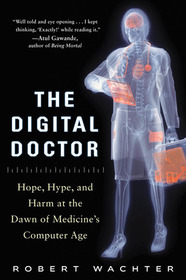
The Digital Doctor: Hope, Hype, and Harm at the Dawn of Medicine’s Computer Age
Series: BUSINESS BOOKS;
- Publisher's listprice GBP 23.99
-
10 831 Ft (10 315 Ft + 5% VAT)
The price is estimated because at the time of ordering we do not know what conversion rates will apply to HUF / product currency when the book arrives. In case HUF is weaker, the price increases slightly, in case HUF is stronger, the price goes lower slightly.
- Discount 10% (cc. 1 083 Ft off)
- Discounted price 9 748 Ft (9 284 Ft + 5% VAT)
Subcribe now and take benefit of a favourable price.
Subscribe
10 831 Ft

Availability
Estimated delivery time: In stock at the publisher, but not at Prospero's office. Delivery time approx. 3-5 weeks.
Not in stock at Prospero.
Why don't you give exact delivery time?
Delivery time is estimated on our previous experiences. We give estimations only, because we order from outside Hungary, and the delivery time mainly depends on how quickly the publisher supplies the book. Faster or slower deliveries both happen, but we do our best to supply as quickly as possible.
Product details:
- Publisher McGraw Hill
- Date of Publication 16 May 2015
- ISBN 9780071849463
- Binding Hardback
- No. of pages352 pages
- Size 233x165x30 mm
- Weight 569 g
- Language English 0
Categories
Short description:
1 Most Influential Physician-Executive in the US
While modern medicine produces miracles, it also delivers care that is too often unsafe, unreliable, unsatisfying, and impossibly expensive. For the past few decades, technology has been touted as the cure for all of healthcare’s ills.
But medicine stubbornly resisted computerization – until now. Over the past five years, thanks largely to billions of dollars in federal incentives, healthcare has finally gone digital.
Yet once clinicians started using computers to actually deliver care, it dawned on them that something was deeply wrong. Why were doctors no longer making eye contact with their patients? How could one of America’s leading hospitals give a teenager a 39-fold overdose of a common antibiotic, despite a state-of-the-art computerized prescribing system? How could a recruiting ad for physicians tout the absence of an electronic medical record as a major selling point?
Logically enough, we’ve pinned the problems on clunky software, flawed implementations, absurd regulations, and bad karma. It was all of those things, but it was also something far more complicated. And far more interesting . . .
Written with a rare combination of compelling stories and hard-hitting analysis by one of the nation’s most thoughtful physicians, The Digital Doctor examines healthcare at the dawn of its computer age. It tackles the hard questions, from how technology is changing care at the bedside to whether government intervention has been useful or destructive. And it does so with clarity, insight, humor, and compassion. Ultimately, it is a hopeful story.
"We need to recognize that computers in healthcare don’t simply replace my doctor’s scrawl with Helvetica 12," writes the author Dr. Robert Wachter. "Instead, they transform the work, the people who do it, and their relationships with each other and with patients. . . . Sure, we should have thought of this sooner. But it’s not too late to get it right."
This riveting book offers the prescription for getting it right, making it essential reading for everyone – patient and provider alike – who cares about our healthcare system.
MoreLong description:
The New York Times Science Bestseller from Robert Wachter, Modern Healthcare’s
The New York Times Science Bestseller from Robert Wachter, Modern Healthcare’s #1 Most Influential Physician-Executive in the US
While modern medicine produces miracles, it also delivers care that is too often unsafe, unreliable, unsatisfying, and impossibly expensive. For the past few decades, technology has been touted as the cure for all of healthcare’s ills.
But medicine stubbornly resisted computerization – until now. Over the past five years, thanks largely to billions of dollars in federal incentives, healthcare has finally gone digital.
Yet once clinicians started using computers to actually deliver care, it dawned on them that something was deeply wrong. Why were doctors no longer making eye contact with their patients? How could one of America’s leading hospitals give a teenager a 39-fold overdose of a common antibiotic, despite a state-of-the-art computerized prescribing system? How could a recruiting ad for physicians tout the absence of an electronic medical record as a major selling point?
Logically enough, we’ve pinned the problems on clunky software, flawed implementations, absurd regulations, and bad karma. It was all of those things, but it was also something far more complicated. And far more interesting . . .
Written with a rare combination of compelling stories and hard-hitting analysis by one of the nation’s most thoughtful physicians, The Digital Doctor examines healthcare at the dawn of its computer age. It tackles the hard questions, from how technology is changing care at the bedside to whether government intervention has been useful or destructive. And it does so with clarity, insight, humor, and compassion. Ultimately, it is a hopeful story.
"We need to recognize that computers in healthcare don’t simply replace my doctor’s scrawl with Helvetica 12," writes the author Dr. Robert Wachter. "Instead, they transform the work, the people who do it, and their relationships with each other and with patients. . . . Sure, we should have thought of this sooner. But it’s not too late to get it right."
This riveting book offers the prescription for getting it right, making it essential reading for everyone – patient and provider alike – who cares about our healthcare system.
MoreTable of Contents:
1 Most Influential Physician-Executive in the US
While modern medicine produces miracles, it also delivers care that is too often unsafe, unreliable, unsatisfying, and impossibly expensive. For the past few decades, technology has been touted as the cure for all of healthcare’s ills.
But medicine stubbornly resisted computerization – until now. Over the past five years, thanks largely to billions of dollars in federal incentives, healthcare has finally gone digital.
Yet once clinicians started using computers to actually deliver care, it dawned on them that something was deeply wrong. Why were doctors no longer making eye contact with their patients? How could one of America’s leading hospitals give a teenager a 39-fold overdose of a common antibiotic, despite a state-of-the-art computerized prescribing system? How could a recruiting ad for physicians tout the absence of an electronic medical record as a major selling point?
Logically enough, we’ve pinned the problems on clunky software, flawed implementations, absurd regulations, and bad karma. It was all of those things, but it was also something far more complicated. And far more interesting . . .
Written with a rare combination of compelling stories and hard-hitting analysis by one of the nation’s most thoughtful physicians, The Digital Doctor examines healthcare at the dawn of its computer age. It tackles the hard questions, from how technology is changing care at the bedside to whether government intervention has been useful or destructive. And it does so with clarity, insight, humor, and compassion. Ultimately, it is a hopeful story.
"We need to recognize that computers in healthcare don’t simply replace my doctor’s scrawl with Helvetica 12," writes the author Dr. Robert Wachter. "Instead, they transform the work, the people who do it, and their relationships with each other and with patients. . . . Sure, we should have thought of this sooner. But it’s not too late to get it right."
This riveting book offers the prescription for getting it right, making it essential reading for everyone – patient and provider alike – who cares about our healthcare system.
More
