

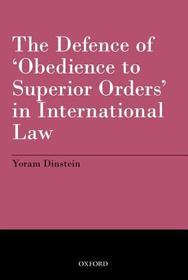
The Defence of 'Obedience to Superior Orders' in International Law
- Publisher's listprice GBP 59.00
-
26 638 Ft (25 370 Ft + 5% VAT)
The price is estimated because at the time of ordering we do not know what conversion rates will apply to HUF / product currency when the book arrives. In case HUF is weaker, the price increases slightly, in case HUF is stronger, the price goes lower slightly.
- Discount 10% (cc. 2 663 Ft off)
- Discounted price 23 975 Ft (22 833 Ft + 5% VAT)
Subcribe now and take benefit of a favourable price.
Subscribe
26 638 Ft

Availability
printed on demand
Why don't you give exact delivery time?
Delivery time is estimated on our previous experiences. We give estimations only, because we order from outside Hungary, and the delivery time mainly depends on how quickly the publisher supplies the book. Faster or slower deliveries both happen, but we do our best to supply as quickly as possible.
Product details:
- Publisher OUP Oxford
- Date of Publication 25 October 2012
- ISBN 9780199670819
- Binding Paperback
- No. of pages304 pages
- Size 233x161x17 mm
- Weight 460 g
- Language English 0
Categories
Short description:
A republication of this highly significant work of 1965, this book addresses the defence of superior orders in the context of national and international law, providing a detailed analysis that remains relevant. With a new preface by the author, this book is an accessible text for scholars and practitioners of international criminal law.
MoreLong description:
The first comprehensive monograph on the defence of superior orders after the second world war, which remains pre-eminent in the field, the republication of this highly-sophisticated work once again makes this book available to scholars and students in the field. First published in 1965, Yoram Dinstein set the standard for future analysis of this issue, providing a ground-breaking interpretation that integrated domestic and international law to provide a subtle and nuanced challenge to the countervailing perceptions of the time, shaped as they were by the Nuremburg and Eichmann trials. The recent jurisprudence of the ad hoc Tribunals has shown remarkably similar analyses to those offered by Dinstein in this book, demonstrating that this key work remains relevant today.
Reviewing the relevant precedents that existed at the time, this book shows that superior orders were not, in and of themselves, a defence, but that orders were relevant to other defences, and therefore should not be entirely ignored. Assessing the issue on a conceptual and practical level, and offering an extraordinary level of detail, this is a is a seminal work in international criminal law. It makes required reading for scholars, students, and practitioners of international criminal law.
"The Defence is a seminal work in international, criminal, and domestic law... the most telling thing that can
be said about the specifics of the argumentation in The Defence is that whenever I think that I have a new idea about superior orders, the first thing I do is to look to see whether it is already there in The Defence. More often than not it is. That is not the only reason that I think The Defence is so important. It is also extremely
significant that at a methodological level it paved the way for, and showed the necessity of, the integration of international law and criminal law scholarship, and its contribution to both is what international criminal lawyers ought to always bear in mind."
Table of Contents:
Part I: National Law
The Dilemma and its Solutions
The Leipzig Trials
Part II: International Theory
The Manifest Illegality Principle and the Personal Knowledge Principle
The Doctrine of Respondeat Superior
The Doctrine of Absolute Liability
The Mens Rea Principle
Part III: International Legislation, 1919-1945
Initial Irresolution
The Negation of the Plea of Obedience to Superior Orders
Part IV: The Cases
Trials before International Tribunals
Trials before National Courts
Part V: International Legislation Since 1946
Doubts and Vacillations
The Work of the International Law Commission
Conclusions

