

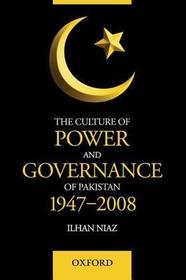
The Culture of Power and Governance of Pakistan
- Publisher's listprice GBP 11.99
-
5 413 Ft (5 155 Ft + 5% VAT)
The price is estimated because at the time of ordering we do not know what conversion rates will apply to HUF / product currency when the book arrives. In case HUF is weaker, the price increases slightly, in case HUF is stronger, the price goes lower slightly.
- Discount 10% (cc. 542 Ft off)
- Discounted price 4 871 Ft (4 640 Ft + 5% VAT)
Subcribe now and take benefit of a favourable price.
Subscribe
5 413 Ft

Availability
Out of print
Why don't you give exact delivery time?
Delivery time is estimated on our previous experiences. We give estimations only, because we order from outside Hungary, and the delivery time mainly depends on how quickly the publisher supplies the book. Faster or slower deliveries both happen, but we do our best to supply as quickly as possible.
Product details:
- Publisher OUP Pakistan
- Date of Publication 28 July 2011
- ISBN 9780199063420
- Binding Paperback
- No. of pages350 pages
- Size 234x156x16 mm
- Weight 442 g
- Language English 0
Categories
Long description:
The Culture of Power and Governance of Pakistan attempts to explain Pakistan's crisis of governance in historical and philosophical terms. It argues that South Asia's indigenous orientation towards the exercise of power has reasserted itself and produced a regression in the behavior of the ruling elite. This has meant that in the sixty years of independence from British rule the behavior of the state apparatus and political class has become more arbitrary,
proprietorial and delusional. The resulting deterioration in the intellectual and moral quality of the state apparatus is a mortal threat to Pakistan. Regrettably, much of the academic and public discussion about developing societies has been vitiated by the heedless repetition of fashionable jargon that
emphasizes national security, democracy and development. The Culture of Power and Governance of Pakistan draws upon the primary declassified record of Pakistan and a diverse array of theoretical inputs to try and balance the debate on the crisis of governance.
Table of Contents:
Introduction
Imperishable Empires
Original Sins
Mandarins
Praetorians
Guardians
Diwans
Grand Seigneurs
Conclusion
Bibliography and Sources
Index

