

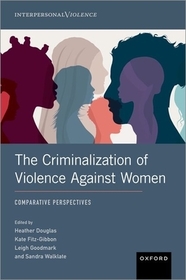
The Criminalization of Violence Against Women
Comparative Perspectives
Series: Interpersonal Violence;
- Publisher's listprice GBP 66.00
-
29 799 Ft (28 380 Ft + 5% VAT)
The price is estimated because at the time of ordering we do not know what conversion rates will apply to HUF / product currency when the book arrives. In case HUF is weaker, the price increases slightly, in case HUF is stronger, the price goes lower slightly.
- Discount 10% (cc. 2 980 Ft off)
- Discounted price 26 819 Ft (25 542 Ft + 5% VAT)
Subcribe now and take benefit of a favourable price.
Subscribe
29 799 Ft

Availability
Estimated delivery time: In stock at the publisher, but not at Prospero's office. Delivery time approx. 3-5 weeks.
Not in stock at Prospero.
Why don't you give exact delivery time?
Delivery time is estimated on our previous experiences. We give estimations only, because we order from outside Hungary, and the delivery time mainly depends on how quickly the publisher supplies the book. Faster or slower deliveries both happen, but we do our best to supply as quickly as possible.
Product details:
- Publisher OUP USA
- Date of Publication 30 November 2023
- ISBN 9780197651841
- Binding Hardback
- No. of pages344 pages
- Size 160x226x35 mm
- Weight 612 g
- Language English 441
Categories
Short description:
Criminalization as a strategy to respond to violence against women is currently being debated across the globe. In North and South America, the United Kingdom, and in Australia the criminalization of coercive control and other types of non-physical forms of abuse are high on national agendas. However, the criminalization path has been unfolding in different ways with many questioning the effectiveness of criminal laws and their impact on victim-survivors. Authors in this collection assess the scope, impact and alternatives to criminalization in the response to violence against women worldwide.
MoreLong description:
Historically states have failed to seriously confront violence against women. In response, in many countries women's rights movements have called on the government to prioritize state intervention in cases involving violence between intimate partners, sexual harassment, rape, and sexual assault by both strangers and intimate partners. Those interventions have taken various forms, including the passage of substantive civil and criminal laws governing intimate partner violence, rape and sexual assault, and sexual harassment; the development of civil orders of protection; and the introduction of procedures in the criminal legal system to ensure the effective intervention of police and prosecutors. Indeed, many countries have relied upon intervention by the criminal legal system to meet their requirements under international human rights standards that obligate states to prevent, protect from, prosecute, punish, and provide redress for violence. Although states have taken divergent approaches to the passage and implementation of criminal laws and procedures to address violence against women, two things are clear: criminalization is a primary strategy relied upon by most nations, and yet criminalization is not having the desired impact.
This collection explores the extent to which nations have adopted criminal legal reforms to address violence against women, the consequences associated with the implementation of those laws and policies, and who bears those consequences most heavily. The chapters examine the need for both more and less criminalization, ask whether we should think differently about criminalization, and explore the tensions that emerge when criminal law, civil law and social policy speak or fail to speak to each other. Drawing on criminalization approaches and recent debates from across the globe, this collection provides a comparative approach to assess the scope, impact of, and alternatives to criminalization in the response to violence against women.
This ground-breaking anthology challenges the widely held belief that all those involved in the feminist movement to end violence against women seek punitive criminal justice responses to the plight of abused women. The readings show that while some feminists still seek increased enforcement of existing laws and harsher penalties for violent men, this is only part of the picture. Many feminists are now at the forefront of progressive efforts to create holistic, non-criminal justice responses and they warrant careful consideration because they effectively address the needs of marginalized survivors that are not met by criminalization.
Table of Contents:
Acknowledgments
Contributors
Introduction: Whither Criminalization?
PART 1: The Criminalization Agenda: "New" Approaches to Old Problems
1. The Criminalization of Coercive Control: The Benefits and Risks of Criminalization from the Vantage of Victim-Survivors
2. The Criminalization of Psychological Violence in Brazil: Challenges of Legal Recognition and Unintended Consequences
3. Criminalization at the Margins: Downblousing, Creepshots and Image-Based Sexual Abuse
4. Sexual Violence in Criminal Law: Presumptions, Principles, and Premises in Relation to the Crime of Negligent Rape
5. Criminal Justice Responses to Domestic Violence in Fiji
PART 2: Criminalization, criminal justice challenges and consequences.
6. Sentencing Aboriginal Women Who Have Killed their Partners: Do We Really Hear Them?
7. United States v. Maddesyn George: The Consequences of Criminalization for Native Women in the United States
8. Prosecuting Intimate Partner Sexual Violence: Reforming Trial Process by Reimagining the Judicial Role
9. "If it's Good for the Goose, it's Good for the Gander": Perceptions of Police Family Violence Policy Adherence in Victoria, Australia
10. Operationalizing Coercive Control: Early Insights on The Policing Of The Domestic Abuse (Scotland) Act 2018
11. The Consequences of Criminalizing Domestic Violence: A Case Study of the Non-Fatal Strangulation Offense in Queensland, Australia
PART 3: Making Sense of Criminalization: Concepts, Context, Activism
12. Human Rights Penality, the Inter-American Approach to Violence Against Women, and the Local Effects of Centring Criminal Justice
13. Intersectionality, Vulnerability, and Punitiveness: Claims of Equality Merging into Categories of Penal Exclusion and Secondary Victimization
14. Dangerous Liaisons: Restorative Justice and the State
15. Bureaucratic Violence: State Neglect of Domestic and Family Violence Victims in Aceh, Indonesia
16. Reclaiming Justice: Understanding the Role of the State and the Collective in Domestic Violence in India.

