

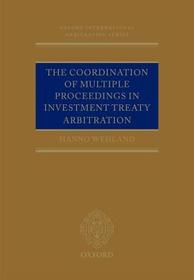
The Coordination of Multiple Proceedings in Investment Treaty Arbitration
Series: Oxford International Arbitration Series;
- Publisher's listprice GBP 265.00
-
119 647 Ft (113 950 Ft + 5% VAT)
The price is estimated because at the time of ordering we do not know what conversion rates will apply to HUF / product currency when the book arrives. In case HUF is weaker, the price increases slightly, in case HUF is stronger, the price goes lower slightly.
- Discount 10% (cc. 11 964 Ft off)
- Discounted price 107 683 Ft (102 555 Ft + 5% VAT)
Subcribe now and take benefit of a favourable price.
Subscribe
119 647 Ft

Availability
printed on demand
Why don't you give exact delivery time?
Delivery time is estimated on our previous experiences. We give estimations only, because we order from outside Hungary, and the delivery time mainly depends on how quickly the publisher supplies the book. Faster or slower deliveries both happen, but we do our best to supply as quickly as possible.
Product details:
- Publisher OUP Oxford
- Date of Publication 20 June 2013
- ISBN 9780199684861
- Binding Hardback
- No. of pages304 pages
- Size 248x177x22 mm
- Weight 664 g
- Language English 30
Categories
Short description:
This is the first work to comprehensively address the issues arising in the context of multiple proceedings before investment treaty tribunals and propose a systematic approach to applicable coordination mechanisms based on a methodical review of international investment agreements, arbitration rules, arbitral decisions, and legal commentary.
MoreLong description:
This is the first systematic analysis of multiple proceedings arising from investor-state disputes, including proceedings before multiple arbitral tribunals, the domestic courts of host states, and other forums such as the European Court of Human Rights. It seeks to identify clear, predictable, and sensible coordination mechanisms and to suggest an application of these mechanisms that reduces jurisdictional fragmentation, jurisdictional competition, and the potential for abuse of the complexities of the system of international investment protection.
The author explains how uncertainty in the area extends to several issues: there are doubts as to which forums have jurisdiction over a dispute and to what questions exactly this jurisdiction extends; there are doubts as to the mechanisms that should be applied to coordinate multiple proceedings (including consolidation, hierarchical coordination mechanisms, lis pendens and res judicata, and general principles of comity and prohibition of abuse of process) and how these mechanisms relate to each other; there are also doubts as to the law applicable to coordination mechanisms and the specifics of their application.
The book begins with an examination of the characteristics of the international investment framework that frequently lead to multiple proceedings. It then addresses the issue of determining jurisdiction, a prerequisite for the application of any mechanism for further coordination. The author goes on to examine the role of agreed coordination (such as the consolidation of proceedings) versus 'default' coordination mechanisms; the role of hierarchy of forums in coordination, which he argues is relevant when coordinating treaty proceedings on the one hand and non-treaty proceedings on the other; the principles of lis pendens and res judicata, which he argues apply only under limited circumstances; and concludes with the establishment of guidelines regarding the application of the principles of comity and the prohibition of abuse of process. This inherently practical subject is exclusively concerned with the existing law and seeks to provide serviceable solutions to the uncertainty facing practitioners and scholars in the current climate of investment law.
There is much in this book to admire. The structure is logical, the research is extensive, the referencing is meticulous, and it is written in a clear, accessible, and lucid style. It pays its due to the work of others on which it builds, and makes an impressive contribution to our understanding of the devices which can be called upon to regulate relations between international courts and tribunals faced with investment disputes. With the continuing rise in the number of investment treaty claims, Dr. Wehlandâs work is likely to be frequently consulted by scholars and practitioners in the field, and deserves to be warmly welcomed into the literature.
Table of Contents:
Introduction
Characteristics of the international investment framework leading to multiple proceedings
Determining the jurisdictions of competing forums in the context of investment disputes
Mechanisms for the coordination of multiple investment proceedings
Hierarchy as a coordinative mechanism in investment treaty arbitration
The application of lis pendens and res judicata in investment treaty arbitration
Overarching principles for the coordination of multiple proceedings
Summary of results and outlook

