

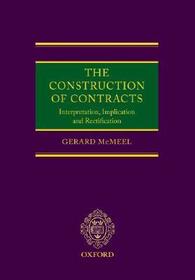
The Construction of Contracts
Interpretation, Implication and Rectification
- Publisher's listprice GBP 135.00
-
60 952 Ft (58 050 Ft + 5% VAT)
The price is estimated because at the time of ordering we do not know what conversion rates will apply to HUF / product currency when the book arrives. In case HUF is weaker, the price increases slightly, in case HUF is stronger, the price goes lower slightly.
- Discount 10% (cc. 6 095 Ft off)
- Discounted price 54 857 Ft (52 245 Ft + 5% VAT)
Subcribe now and take benefit of a favourable price.
Subscribe
60 952 Ft

Availability
Out of print
Why don't you give exact delivery time?
Delivery time is estimated on our previous experiences. We give estimations only, because we order from outside Hungary, and the delivery time mainly depends on how quickly the publisher supplies the book. Faster or slower deliveries both happen, but we do our best to supply as quickly as possible.
Product details:
- Publisher Oxford University Press
- Date of Publication 22 March 2007
- ISBN 9780199277933
- Binding Hardback
- No. of pages648 pages
- Size 246x171x41 mm
- Weight 1232 g
- Language English 0
Categories
Short description:
This new work is a practical guide on the interpretation and effect of written contracts. It provides an up-to-date, clear and comprehensive account of the legal principles and doctrines that come into play whenever parties disagree about the meaning and effect of contractual words.
MoreLong description:
This exciting new practitioner-orientated text provides a clear and comprehensive account of the legal principles and doctrines which come into play whenever the parties disagree about the meaning and effect of the contractual words. Most commercial transactions, from the supply of goods of services to the sale of a business, are reduced to writing. In most cases this entails that the deal is recorded in clear and certain terms for the parties to perform. Nevertheless written
contracts are abundant with disputes about the meaning and effect of particular words and phrases.
Although the common law principles and techniques of construction are of long ancestry, they have recently come to greater prominence as judges have self-consciously sought to modernise the approach to the interpretation of contractual instruments. This work provides a new and refreshed account of the principles involved, focusing on the practitioner's needs, tackling modernisation head on and equipping readers with the necessary means to avoid pitfalls in contractual provisions.
The coverage extends to related rules and doctrines, including rectification and implication of terms, and consideration of the status of the controversial 'parol evidence rule.' The book also considers the nature of effect of particular species of contractual provision, including warranties and indemnities, exemption clauses, 'force majeure' clauses and 'entire agreement' clauses.
Table of Contents:
PART I: THE GENERAL PART
Principles and Policies
Theoretical and Comparative Perspectives
The Objective Principle of Construction
Internal Context: The Whole Contract Approach
External Context: Surrounding Circumstances, 'Matrix' and 'Parol Evidence'
Standard Form Contracts, Public Policy and the Realms of Strict Construction and Strict Compliance
Presumptions
Maxims
New Horizons: Good Faith, Contractual Discretions, and Human Rights
PART II: RELATED DOCTRINES
Implication by Law: General Default Rules
Implication in Fact: Ad hoc Gap-fillers
Custom and Usage
Technical and Legal Language
Formation and Certainty
Incorporation of Terms
Parties, Third Party Effects and Clauses Precluding Assignment
Rectification and Correcting Mistakes through Construction
Common Assumptions, Estoppel by Convention, Estoppel by Deed
Construction and Mistake as a Vitiating Factor
PART III: PARTICULAR CONTRACTUAL PROVISIONS
Conditions, Warranties, and Indemnities
Exemption Clauses
Change of Circumstances and 'Force Majeure' Clauses
Modification of Remedies: Express Termination, Liquidated Damages and No Set Off Clauses
The Integrity of the Instrument: 'Entire Agreement' and 'Non-reliance' Clauses
PART IV: RULES RELATING TO WRITTEN CONTRACTS
The Status of Instruments: Forgeries, Deliberate Alteration, Non est Factum, and Shams
PART V: CONSTRUCTION AND PRACTICE
Evidence: Documents, Originals and Copies

