

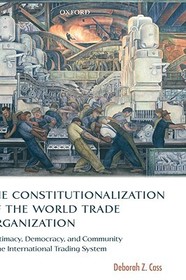
The Constitutionalization of the World Trade Organization
Legitimacy, Democracy, and Community in the International Trading System
Series: International Economic Law Series;
- Publisher's listprice GBP 180.00
-
81 270 Ft (77 400 Ft + 5% VAT)
The price is estimated because at the time of ordering we do not know what conversion rates will apply to HUF / product currency when the book arrives. In case HUF is weaker, the price increases slightly, in case HUF is stronger, the price goes lower slightly.
- Discount 10% (cc. 8 127 Ft off)
- Discounted price 73 143 Ft (69 660 Ft + 5% VAT)
Subcribe now and take benefit of a favourable price.
Subscribe
81 270 Ft

Availability
printed on demand
Why don't you give exact delivery time?
Delivery time is estimated on our previous experiences. We give estimations only, because we order from outside Hungary, and the delivery time mainly depends on how quickly the publisher supplies the book. Faster or slower deliveries both happen, but we do our best to supply as quickly as possible.
Product details:
- Publisher OUP Oxford
- Date of Publication 28 July 2005
- ISBN 9780199284634
- Binding Hardback
- No. of pages296 pages
- Size 241x162x25 mm
- Weight 541 g
- Language English
- Illustrations 1 table 0
Categories
Short description:
What is the World Trade Organization? Does it represent a new constitution for the international economic order? This is a book about the constitutionalization of the World Trade Organization, and the contemporary development of institutional forms and democratic ideas associated with constitutionalism within the world trading system. It is about constitutionalization enthusiasts who promote institutions, management techniques, rights discourse and quasi-judicial power to construct a constitution for the WTO. It is about constitutional skeptics who fear the effect the phenomenon of constitutionalization is having on the autonomy of states, the capacity of the WTO to consider non-economic and non-free-trade goals, and democratic processes at the WTO and within the nation-state. The aim of the study, then, is to disentangle debates about the various meanings of the term 'constitution' when it is used to apply to the World Trade Organization, and to reflect upon the significance of those meanings for more general international law conceptions of constitutions.
MoreLong description:
This is a book about the constitutionalization of the World Trade Organization, and the contemporary development of institutional forms and democratic ideas associated with constitutionalism within the world trading system.
It is about constitutionalization enthusiasts who promote institutions, management techniques, rights discourse and quasi-judicial power to construct a constitution for the WTO. It is about constitutional skeptics who fear the effect the phenomenon of constitutionalization is having on the autonomy of states, the capacity of the WTO to consider non-economic and non-free-trade goals, and democratic processes at the WTO and within the nation-state.
The aim of the study, then, is to disentangle debates about the various meanings of the term 'constitution' when it used to apply to the World Trade Organization, and to reflect upon the significance of those meanings for more general international law conceptions of constitutions.
Cass argues that the WTO is not and should not be described as a constitution, either by the standards of any received account of that term, or by the lights of any of the current WTO models. Under these definitions serious issues of legitimacy, democracy and community are at stake. The WTO would lack a proper political structure to balance the work of its judicial bodies; it may curtail the ability of states to decide matters of national economic interest; it lacks authorization by a coherent political community; and, it risks an emphasis upon economic goals and pure free trade over other, equally important, social values.
Instead, Cass argues that what is needed is a constitutionalized WTO which considers the economic development needs of states and takes account of the skewed playing field of international trade and its effect on the economic prospects of developing countries. In short, trading democracy, legitimacy and community and not trading constitutionalization, are the biggest challenges facing the WTO.
'Deborah Cass has achieved that rare thing: An account which is sophisticated at both a theoretical and a doctrinal level. Her book will be a benchmark for all future writing on this theme.'
Table of Contents:
Preface
Acknowledgements
List of Abbreviations
Table of Cases
Table of International Instruments
PART I: THE ORIGINS OF THE WTO CONSTITUTIONALIZATION DEBATE
INTERNATIONAL TRADE AND CONSTITUTIONALIZATION
CONSTITUTIONALIZATION: THE RECEIVED ACCOUNT
THE INTERNATIONAL ECONOMIC LAW BACKGROUND
PART II: THREE VISIONS OF WTO CONSTITUTIONALIZATION
INSTITUTIONAL MANAGERIALISM
RIGHTS-BASED CONSTITUTIONALIZATION
JUDICIAL NORM-GENERATION
PART III: TRADING DEMOCRACY
ANTI-CONSTITUTIONALIZATION CRITIQUE
CONCLUSION
Bibiography
Index

