

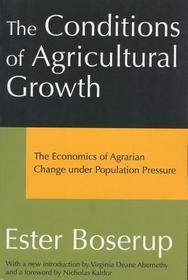
The Conditions of Agricultural Growth
The Economics of Agrarian Change Under Population Pressure
- Publisher's listprice GBP 48.99
-
22 118 Ft (21 065 Ft + 5% VAT)
The price is estimated because at the time of ordering we do not know what conversion rates will apply to HUF / product currency when the book arrives. In case HUF is weaker, the price increases slightly, in case HUF is stronger, the price goes lower slightly.
- Discount 20% (cc. 4 424 Ft off)
- Discounted price 17 695 Ft (16 852 Ft + 5% VAT)
- Discount is valid until: 30 June 2026
Subcribe now and take benefit of a favourable price.
Subscribe
19 906 Ft

Availability
Estimated delivery time: In stock at the publisher, but not at Prospero's office. Delivery time approx. 3-5 weeks.
Not in stock at Prospero.
Why don't you give exact delivery time?
Delivery time is estimated on our previous experiences. We give estimations only, because we order from outside Hungary, and the delivery time mainly depends on how quickly the publisher supplies the book. Faster or slower deliveries both happen, but we do our best to supply as quickly as possible.
Product details:
- Edition number 1
- Publisher Routledge
- Date of Publication 30 June 2005
- Number of Volumes Paperback
- ISBN 9780202307930
- Binding Paperback
- No. of pages132 pages
- Size 229x152 mm
- Weight 249 g
- Language English 0
Categories
Short description:
This book sets out to investigate the process of agrarian change from new angles and with new results
MoreLong description:
This book sets out to investigate the process of agrarian change from new angles and with new results. It starts on firm ground rather than from abstract economic theory. Upon its initial appearance, it was heralded as "a small masterpiece, which economic historians should read--and not simply quote"--Giovanni Frederico, Economic History Services.
The Conditions of Agricultural Growth remains a breakthrough in the theory of agricultural development. In linking ethnography with economy, developmental studies reached new heights. Whereas "development" had been seen previously as the transformation of traditional communities by the introduction (or imposition) of new technologies, Ester Boserup argues that changes and improvements occur from within agricultural communities, and that improvements are governed not simply by external interference, but by those communities themselves Using extensive analyses of the costs and productivity of the main systems of traditional agriculture, Ester Boserup concludes that technical, economic, and social changes are unlikely to take place unless the community concerned is exposed to the pressure of population growth.
MoreTable of Contents:
INTRODUCTION, 1. THE DYNAMICS OF LAND UTILIZATION, 2. THE INTERDEPENDENCE OF LAND USE AND TECHNICAL CHANGE, 3. LABOUR PRODUCTIVITY UNDER LONG-FALLOW AND SHORT-FALLOW SYSTEMS, 4. CARRYING CAPACITY OF LAND AND PRODUCTIVITY OF LABOUR UNDER INTENSIVE AGRICULTURE, 5. POPULATION GROWTH AND WORKING HOURS, 6. THE CO-EXISTENCE OF CULTIVATION SYSTEMS, 7. DIMINISHING RETURNS TO LABOUR AND TECHNICAL INERTIA, 8. THE VICIOUS CIRCLE OF SPARSE POPULATION AND PRIMITIVE TECHNIQUES, 9. SYSTEMS OF LAND USE AS A DETERMINANT OF LAND TENURE, 10. INVESTMENT AND TENURE IN TRIBAL COMMUNITIES, 11. RURAL INVESTMENT UNDER LANDLORD TENURE, 12. INCENTIVES TO INVESTMENT UNDER MODERN TENURE, 13. THE USE OF INDUSTRIAL INPUT IN PRIMITIVE AGRICULTURE, 14. SOME PERSPECTIVES AND IMPLICATIONS, INDEX
More
