

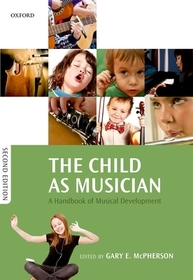
The Child as Musician
A handbook of musical development
- Publisher's listprice GBP 59.00
-
26 638 Ft (25 370 Ft + 5% VAT)
The price is estimated because at the time of ordering we do not know what conversion rates will apply to HUF / product currency when the book arrives. In case HUF is weaker, the price increases slightly, in case HUF is stronger, the price goes lower slightly.
- Discount 10% (cc. 2 663 Ft off)
- Discounted price 23 975 Ft (22 833 Ft + 5% VAT)
Subcribe now and take benefit of a favourable price.
Subscribe
26 638 Ft

Availability
printed on demand
Why don't you give exact delivery time?
Delivery time is estimated on our previous experiences. We give estimations only, because we order from outside Hungary, and the delivery time mainly depends on how quickly the publisher supplies the book. Faster or slower deliveries both happen, but we do our best to supply as quickly as possible.
Product details:
- Edition number 2
- Publisher OUP Oxford
- Date of Publication 26 October 2017
- ISBN 9780198817154
- Binding Paperback
- No. of pages704 pages
- Size 247x170x36 mm
- Weight 1158 g
- Language English 30
Categories
Short description:
The new edition of 'The Child as Musician' celebrates the richness and diversity of the many different ways in which children can engage in and interact with music. It presents theory - both cutting edge and classic - in an accessible way for readers by surveying research concerned with the development and acquisition of musical skills
MoreLong description:
The new edition of The Child as Musician: A Handbook of Musical Development celebrates the richness and diversity of the many different ways in which children can engage in and interact with music. It presents theory - both cutting edge and classic - in an accessible way for readers by surveying research concerned with the development and acquisition of musical skills. The focus is on musical development from conception to late adolescences, although the bulk of the coverage concentrates on the period when children are able to begin formal music instruction (from around age 3) until the final year of formal schooling (around age 18).
There are many conceptions of how musical development might take place, just as there are for other disciplines and areas of human potential. Consequently, the publication highlights the diversity in current literature dealing with how we think about and conceptualise children's musical development. Each of the authors has searched for a better and more effective way to explain in their own words and according to their own perspective, the remarkable ways in which children engage with music.
In the field of educational psychology there are a number of publications that survey the issues surrounding child and adolescent development. Some of the more innovative present research and theories, and their educational implications, in a style that stresses the fundamental interplay among the biological, environmental, social and cultural influences at each stage of a child's development. Until now, no similar overview has existed for child and adolescent development in the field of music. The Child as Musician addresses this imbalance, and is essential for those in the fields of child development, music education, and music cognition.
Table of Contents:
Section 1: Development
Prenatal Development
Reflections on Infants as Musical Connoisseurs
The Child Musician's Brain
Musicality
Music cognition in childhood
Musical Agency
The potential impact of autism on musical development
Section 2: Engagement
Music and Nonmusical Abilities
Musical Literacy: Reading traditional clef notation
Musical Literacy: Music as language
Engaging in a sound musicianship
Underlying Mechanisms and Processes in the Development of Emotion Perception in Music
Felt Experiences of Popular Musics
Children, Popular Music, and Identity
The Child as Music Critic
How and why do musical preferences change in childhood and adolescence?
Section 3: Differences
Motivation
Building gifts into musical talents
Inclusive Music Classrooms: A Universal Approach
Music and Wellbeing during Illness
Adolescent Music Is Not Problematic
Section 4: Skills
Playing an instrument
Building performance confidence
Singing and vocal development
Musical play
The Individual and Social Worlds of Children's Musical Creativities
Computer-Based Technology
Section 5: Contexts
Historical Perspectives
Child as Musical Apprentice
Global Practices
Transcultural Childhoods
My Voice is Important Too: Non-formal Music Experiences and Young People
Transformative Music Engagement and Musical Flourishing
The transition from adolescent to adult music learner
Fostering lifelong engagement in music

