

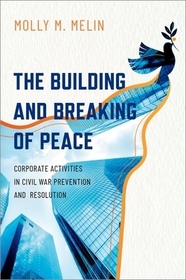
The Building and Breaking of Peace
Corporate Activities in Civil War Prevention and Resolution
- Publisher's listprice GBP 45.99
-
20 764 Ft (19 775 Ft + 5% VAT)
The price is estimated because at the time of ordering we do not know what conversion rates will apply to HUF / product currency when the book arrives. In case HUF is weaker, the price increases slightly, in case HUF is stronger, the price goes lower slightly.
- Discount 10% (cc. 2 077 Ft off)
- Discounted price 18 687 Ft (17 798 Ft + 5% VAT)
Subcribe now and take benefit of a favourable price.
Subscribe
20 764 Ft

Availability
Estimated delivery time: In stock at the publisher, but not at Prospero's office. Delivery time approx. 3-5 weeks.
Not in stock at Prospero.
Why don't you give exact delivery time?
Delivery time is estimated on our previous experiences. We give estimations only, because we order from outside Hungary, and the delivery time mainly depends on how quickly the publisher supplies the book. Faster or slower deliveries both happen, but we do our best to supply as quickly as possible.
Product details:
- Publisher OUP USA
- Date of Publication 25 October 2021
- ISBN 9780197579367
- Binding Hardback
- No. of pages264 pages
- Size 229x150x22 mm
- Weight 522 g
- Language English 132
Categories
Short description:
Including original cross-national data and in-depth case analyses of corporate actions and outcomes in Colombia, Northern Ireland, and Tunisia, The Building and Breaking of Peace shows that corporations help to prevent violence but not resolve it. In examining the corporate motives for peacebuilding and the implications of these activities for preventing violence and conflict resolution, Molly M. Melin builds a more holistic picture of the peace and conflict process. The findings also help explain why armed civil conflicts persist despite the multitude of diverse actors working to end them.
MoreLong description:
Private corporations are rarely discussed as playing a role in efforts to curb civil violence, even though they often have strong interests in maintaining stability. Violence often damages the infrastructure necessary to deliver goods to market or may directly target companies. Corporations also have a normative obligation to conduct business in ways that promote peace. While there are historical examples of firm-instigated violence and firms reaping benefits from instability and conflict, there is also evidence that corporations proactively engage in peacebuilding. For example, firms devise programs to promote economic development, offer access to education, and employ former combatants.
In The Building and Breaking of Peace, Molly M. Melin develops a theory of the conflicting roles corporations play in both building and preventing peace. Melin shows that corporations engage in peacebuilding when there is a gap in the state's capacity to enforce laws, but they also weigh the opportunity costs of peacebuilding, responding to the need for action when conditions enable them to do so. Firms are uniquely situated in their ability to raise the cost of violence, and proactive firms can increase the years of peace in a country. At the same time, an active private sector can make it harder for states with ongoing conflict to reach an agreement, as they act as an additional veto player in the bargaining process.
Including original cross-national data of peacebuilding efforts by firms in Latin America, the Middle East, and Africa from 2000 to 2018, and in-depth case analyses of corporate actions and outcomes in Colombia, Northern Ireland, and Tunisia, Melin shows that corporations help to prevent violence but not resolve it. In examining the corporate motives for peacebuilding and the implications of these activities for preventing violence and conflict resolution, the book builds a more holistic picture of the peace and conflict process. The findings also help explain why armed civil conflicts persist despite the multitude of diverse actors working to end them.
The Building and Breaking of Peace is an intriguing first cut at examining corporate peacebuilding actions and effects with a political science lens.
Table of Contents:
CHAPTER 1
INTRODUCTION: THE PUZZLE OF CORPORATIONS, CONFLICT PREVENTION AND CONFLICT RESOLUTION
CHAPTER 2
THE STATE OF OUR KNOWLEDGE: VARIED APPROACHES TO UNDERSTANDING CORPORATE ENGAGEMENT
CHAPTER 3
PEACEBUILDING: DEFINITION, ACTORS, FRAMEWORK & MEASUREMENT
CHAPTER 4
SUPPLYING PEACE: WHICH CORPORATIONS BUILD PEACE?
CHAPTER 5
THE BUILDING AND BREAKING OF PEACE: UNDERSTANDING CORPORATE EFFECTS ON CONFLICT PREVENTION AND RESOLUTION
CHAPTER 6
CORPORATIONS, CONFLICT PREVENTION, AND RESOLUTION IN COLOMBIA
CHAPTER 7
CONFLICT TRANSFORMATION AND PREVENTION IN TUNISIA
CHAPTER 8
TRANSNATIONAL CORPORATIONS AND CONFLICT RESOLUTION IN NORTHERN IRELAND
CHAPTER 9
CONCLUSION

