

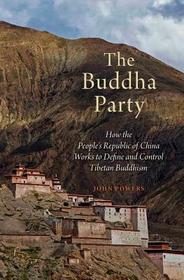
The Buddha Party
How the People's Republic of China Works to Define and Control Tibetan Buddhism
- Publisher's listprice GBP 42.99
-
19 409 Ft (18 485 Ft + 5% VAT)
The price is estimated because at the time of ordering we do not know what conversion rates will apply to HUF / product currency when the book arrives. In case HUF is weaker, the price increases slightly, in case HUF is stronger, the price goes lower slightly.
- Discount 20% (cc. 3 882 Ft off)
- Discounted price 15 527 Ft (14 788 Ft + 5% VAT)
- Discount is valid until: 30 June 2026
Subcribe now and take benefit of a favourable price.
Subscribe
19 409 Ft

Availability
Estimated delivery time: In stock at the publisher, but not at Prospero's office. Delivery time approx. 3-5 weeks.
Not in stock at Prospero.
Why don't you give exact delivery time?
Delivery time is estimated on our previous experiences. We give estimations only, because we order from outside Hungary, and the delivery time mainly depends on how quickly the publisher supplies the book. Faster or slower deliveries both happen, but we do our best to supply as quickly as possible.
Product details:
- Publisher OUP USA
- Date of Publication 20 October 2016
- ISBN 9780199358151
- Binding Hardback
- No. of pages392 pages
- Size 155x236x35 mm
- Weight 635 g
- Language English 0
Categories
Short description:
The Buddha Party tells the story of how the People's Republic of China employs propaganda to define Tibetan Buddhist belief and sway opinion within the country and abroad.
MoreLong description:
The Buddha Party tells the story of how the People's Republic of China employs propaganda to define Tibetan Buddhist belief and sway opinion within the country and abroad. The narrative they create is at odds with historical facts and deliberately misleading, but, John Powers argues, it is widely believed by Han Chinese. Most of China's leaders appear to deeply believe the official line regarding Tibet, which resonates with Han notions of themselves as China's most advanced nationality and as a benevolent race that liberates and culturally uplifts minority peoples. This in turn profoundly affects how the leadership interacts with their counterparts in other countries. Powers's study focuses in particular on the government's "patriotic education" campaign-an initiative that forces monks and nuns to participate in propaganda sessions and repeat official dogma. Powers contextualizes this within a larger campaign to transform China's religions into "patriotic" systems that endorse Communist Party policies. This book offers a powerful, comprehensive examination of this ongoing phenomenon, how it works and how Tibetans resist it.
The Buddha Party is an excellent book that will be essential reading for students of contemporary Tibet. It is a handy and accessible classroom resource for courses on contemporary China that address the PRC's ethnic policies and the status of the country's ethnic nationalities. The book focuses on Tibetans, but it is highly relevant for understanding Chinese nationalism and the narratives that underpin the Chinese Dream -- Xi Jinping's vision for the great rejuvenation of China. It will also be helpful to those wishing to gain a greater understanding of current events in Xinjiang, where Islam is being similarly targeted as a threat to national integration and China's return to world power status.
Table of Contents:
Acknowledgements
Preface
1 Acts of Ingratitude
2 The Limitations of Propaganda
3 Patriotic Soul Boys and Other Chinese Myths
4 Tibetology with Chinese Characteristics
5 Chinese and Tibetan Perspectives on History
6 Conclusion
Appendix A: Tibetan Spellings
Appendix B: Chinese Terms
Appendix C: Buddhist Terms
Notes
Bibliography
Index

