

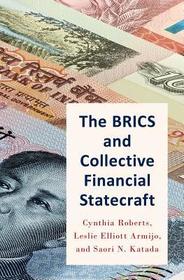
The BRICS and Collective Financial Statecraft
- Publisher's listprice GBP 39.99
-
18 055 Ft (17 195 Ft + 5% VAT)
The price is estimated because at the time of ordering we do not know what conversion rates will apply to HUF / product currency when the book arrives. In case HUF is weaker, the price increases slightly, in case HUF is stronger, the price goes lower slightly.
- Discount 10% (cc. 1 806 Ft off)
- Discounted price 16 249 Ft (15 476 Ft + 5% VAT)
Subcribe now and take benefit of a favourable price.
Subscribe
18 055 Ft

Availability
printed on demand
Why don't you give exact delivery time?
Delivery time is estimated on our previous experiences. We give estimations only, because we order from outside Hungary, and the delivery time mainly depends on how quickly the publisher supplies the book. Faster or slower deliveries both happen, but we do our best to supply as quickly as possible.
Product details:
- Publisher OUP USA
- Date of Publication 7 December 2017
- ISBN 9780190697525
- Binding Paperback
- No. of pages288 pages
- Size 155x231x17 mm
- Weight 454 g
- Language English 0
Categories
Short description:
The BRICS (China, Russia, India, Brazil, and South Africa), an exclusive international club, perceive an ongoing global power shift and contest the West's pretensions to permanent stewardship of the liberal economic order. Against expectations, they have exercised collective financial statecraft with remarkable success to seek reforms, influence, and leadership roles.
MoreLong description:
In the first decade of the 21st century, five rising powers (Brazil, Russia, India, China, and South Africa) formed an exclusive and informal international club, the BRICS. Although neither revolutionaries nor extreme revisionists, the BRICS perceive an ongoing global power shift and contest the West's pretensions to permanent stewardship of the existing economic order. Together they have exercised collective financial statecraft, employing their expanding financial and monetary capabilities for the purpose of achieving larger foreign policy goals. This volume examines the forms and strategies of such collective financial statecraft, and the motivations of each individual government for collaborating through the BRICS club. Their cooperative financial statecraft takes various forms, ranging from pressure for "inside reforms" of either multilateral institutions or global markets, to "outside options" exercised through creating new multilateral institutions or jointly pushing for new realities in international financial markets. To the surprise of many observers, the joint actions of the BRICS are largely successful. Although each member has its unique rationale for collaboration, the largest member, China, controls resources that permit it the greatest influence in intra-club decision-making. The BRICS cooperate due to both common aversions (for example, resentment over being perennial junior partners in global economic and financial governance and resistance to infringements on their autonomy due to U.S. dollar dominance and financial power) and common interests (such as obtaining greater voice in international institutions, as the IMF). The group seeks reforms, influence, and enhanced leadership roles within the liberal capitalist global system. Where blocked, they experiment with parallel multilateral institutions in which they are the dominant rule-makers. The future of the BRICS depends not only on their bargaining power and adjustment to market players, but also on their ability to overcome domestic impediments to sustainable economic growth, the basis for their international influence.
This book provides an authoritative, comprehensive, and lucid account of the rise of the BRICS. A compelling narrative about how a group of economies, which have some congruent interests but are simultaneously competitors in many other areas, have set aside their differences and come together as a force to reckon with in global finance.
Table of Contents:
Introduction: The BRICS as a Club
BRICS in the Aftermath of the Global Financial Crisis
Strategic Incentives in Unipolarity and Common Aversions
The BRICS and the Global Governance System
Formal Institutions and Informal Powers: The Emergence of Clubs
The BRICS as a Club
Clubs with Power Asymmetries and Dominant Powers with Outisde Options
Plan of the Book
Global Power Shift: The BRICS, Building Capabilities for Influence
Conceptualizing Power
Measuring the Shift in Economic Capabilities
A New, Multipolar World?
The Global Financial and Monetary Capabilities of the BRICS
Redback Rising
Conclusions
BRICS Collective Financial Statecraft: Four Cases
Defining Collective Financial Statecraft
Four Categories of Collective Financial Statecraft
Inside Reforms: The BRICS Quest for Greater Influence Within the IMF and World Bank (Case 1)
Inside Reforms: Resist Manipulation of Financial Market Power for U.S./Western Political Aims (Case 2)
Outside Options: Create Parallel Financial Institutions Controlled by the BRICS (Case 3)
Outside Options: Diminish Dollar Dominance and Build the Financial Market
Power of the RMB (Case 4)
Future Directions and Cooperative Opportunities Not Taken
Conclusion: Mostly Successful BRICS Collective Financial Statecraft
Motives for BRICS Collaboration: Views from the Five Capitals
Six Propositions
The View from Beijing: In Search of Legitimacy and Unthreatening Leadership
The View from Moscow: Russias Struggle for Autonomy and International Influence
The View from New Delhi: Amplifying Voice and Anticipating Multipolarity
The View from Brasília: Enhancing Status and Inviting Investment
The View from Pretoria: Support for Growth and Regional Leadership
Conclusions: Explaining BRICS Collaboration
Conclusion: Whither the BRICS?
BRICS and World Order: Too Much Pessimism Is Unwarranted
Growth: The Essential Need to Return to the BRICS Roots
The Tension Between Formal and Informal Rules
Summing up: The BRICS, Collective Financial Statecraft, and the Multipolar Future
Notes
Index

