

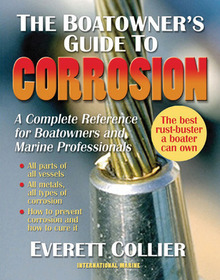
The Boatowner's Guide to Corrosion
A Complete Reference for Boatowners and Marine Professionals
Series: INTERNATIONAL MARINE-RMP;
- Publisher's listprice GBP 24.99
-
11 938 Ft (11 370 Ft + 5% VAT)
The price is estimated because at the time of ordering we do not know what conversion rates will apply to HUF / product currency when the book arrives. In case HUF is weaker, the price increases slightly, in case HUF is stronger, the price goes lower slightly.
- Discount 10% (cc. 1 194 Ft off)
- Discounted price 10 745 Ft (10 233 Ft + 5% VAT)
Subcribe now and take benefit of a favourable price.
Subscribe
11 938 Ft

Availability
printed on demand
Why don't you give exact delivery time?
Delivery time is estimated on our previous experiences. We give estimations only, because we order from outside Hungary, and the delivery time mainly depends on how quickly the publisher supplies the book. Faster or slower deliveries both happen, but we do our best to supply as quickly as possible.
Product details:
- Publisher International Marine
- Date of Publication 16 August 2006
- ISBN 9780071475440
- Binding Paperback
- No. of pages320 pages
- Size 236x190x17 mm
- Weight 550 g
- Language English 0
Categories
Short description:
“The best explanation that I have seen of corrosion on boats.”—Nigel Calder, author of Boatowner’s Mechanical and Electrical Manual
“A powerful weapon in the war against metal deterioration.”—Cruising World
Corrosion is a constant, often expensive, and sometimes dangerous problem for boaters. Moisture, salt, electrical currents, and chemicals create a potent combination that can attack the metallic (and sometimes nonmetallic) parts of your boat. Everett Collier, an expert in marine technology, details all the types of corrosion—including simple galvanic, electrochemical, and electrolytic—and explains how to identify, combat, and prevent them. The most comprehensive book on this subject, The Boatowner's Guide to Corrosion shows you how to:
- Prevent corrosion with proper grounding, cathodic protection, protective coatings, and careful selection and matching of metal parts
- Protect your boat’s hull, deck gear, masts, and rigging, as well as its propulsion, electrical, plumbing, and steering systems
- Recognize and cure developing corrosion before it can damage your boat
Everett Collier is an electrical engineer and amateur boatbuilder who lectures and consults in advanced manufacturing technology management. An avid cruising sailor, he also serves as an adjunct faculty member at Northern Essex Community College and writes for marine industry magazines including National Fisherman.
MoreLong description:
“The best explanation that I have seen of corrosion on boats.”—Nigel Calder, author of Boatowner’s Mechanical and Electrical Manual
“A powerful weapon in the war against metal deterioration.”—Cruising World
Corrosion is a constant, often expensive, and sometimes dangerous problem for boaters. Moisture, salt, electrical currents, and chemicals create a potent combination that can attack the metallic (and sometimes nonmetallic) parts of your boat. Everett Collier, an expert in marine technology, details all the types of corrosion—including simple galvanic, electrochemical, and electrolytic—and explains how to identify, combat, and prevent them. The most comprehensive book on this subject, The Boatowner's Guide to Corrosion shows you how to:
- Prevent corrosion with proper grounding, cathodic protection, protective coatings, and careful selection and matching of metal parts
- Protect your boat’s hull, deck gear, masts, and rigging, as well as its propulsion, electrical, plumbing, and steering systems
- Recognize and cure developing corrosion before it can damage your boat
“The best explanation that I have seen of corrosion on boats.”—Nigel Calder, author of Boatowner’s Mechanical and Electrical Manual
“A powerful weapon in the war against metal deterioration.”—Cruising World
Corrosion is a constant, often expensive, and sometimes dangerous problem for boaters. Moisture, salt, electrical currents, and chemicals create a potent combination that can attack the metallic (and sometimes nonmetallic) parts of your boat. Everett Collier, an expert in marine technology, details all the types of corrosion—including simple galvanic, electrochemical, and electrolytic—and explains how to identify, combat, and prevent them. The most comprehensive book on this subject, The Boatowner's Guide to Corrosion shows you how to:
- Prevent corrosion with proper grounding, cathodic protection, protective coatings, and careful selection and matching of metal parts
- Protect your boat’s hull, deck gear, masts, and rigging, as well as its propulsion, electrical, plumbing, and steering systems
- Recognize and cure developing corrosion before it can damage your boat

