

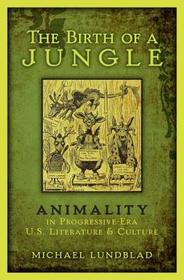
The Birth of a Jungle
Animality in Progressive-Era U.S. Literature and Culture
- Publisher's listprice GBP 92.00
-
41 538 Ft (39 560 Ft + 5% VAT)
The price is estimated because at the time of ordering we do not know what conversion rates will apply to HUF / product currency when the book arrives. In case HUF is weaker, the price increases slightly, in case HUF is stronger, the price goes lower slightly.
- Discount 10% (cc. 4 154 Ft off)
- Discounted price 37 384 Ft (35 604 Ft + 5% VAT)
Subcribe now and take benefit of a favourable price.
Subscribe
41 538 Ft

Availability
printed on demand
Why don't you give exact delivery time?
Delivery time is estimated on our previous experiences. We give estimations only, because we order from outside Hungary, and the delivery time mainly depends on how quickly the publisher supplies the book. Faster or slower deliveries both happen, but we do our best to supply as quickly as possible.
Product details:
- Publisher OUP USA
- Date of Publication 7 March 2013
- ISBN 9780199917570
- Binding Hardback
- No. of pages240 pages
- Size 163x236x20 mm
- Weight 454 g
- Language English
- Illustrations 7 illustrations 0
Categories
Short description:
The Birth of a Jungle probes the historical emergence of the jungle as a discourse in the U.S during the Progressive Era.
MoreLong description:
Exemplifying a new methodology identified as'animality studies' that focuses on constructions of animality at specific historical and cultural moments, without the explicit emphasis on animal advocacy that is often found in animal studies, this book explores animality at the turn of the twentieth century in the United States. At that moment, shifts in what it meant to be both 'human' and 'animal' became crucial in terms of producing new ways of thinking about a wide range of human behaviors, including homosexuality, labor exploitation, and the lynching of black men. The discourse of 'the jungle' was born at the confluence of Darwin and Freud, once human behavior could be explained, supposedly, by animal instincts that were naturally violent in the name of survival and heterosexual in the name of reproduction. Literary and cultural texts at the turn of the twentieth century produced new ways of thinking about the 'beast within' shifting away from a Protestant Christian formulation of a devilish inner beast that was sinful and violent. But the central argument here is that Darwinist-Freudian formulations of the human animal, despite reigning critical interpretations, were often contested rather than reinforced by writers such as Jack London, Henry James, Frank Norris, Upton Sinclair, Edgar Rice Burroughs, and William James, as well as cultural events such as a circus elephant publicly electrocuted at Coney Island, an African man on display in the Monkey House of the Bronx Zoo, and the Scopes "Monkey Trial." Ultimately, this book reveals not only new ways of thinking about familiar texts, but also the significance of the question of the animal in relation to fields such as the history of sexuality, studies of literary naturalism, and critical race studies within American literary and cultural studies. The book reveals how the figure of the animal evolved in U.S. literature and culture at the turn of the century, particularly through the birth of the jungle: a discourse that continues to enable enduring justifications of homophobia, economic exploitation, and racism in the United States and beyond.
...Lundblad's The Birth of a Jungle is a remarkable achievement and an important contribution to the study of Progressive-Era literature and culture. ... By analyzing animals and environments as discursive formations that produce a range of power relations and identity formations, Lundblad's work ultimately suggests that we ought to supplement our contemporary political contestations over 'actual' animals and environments with a cultural politics that attends just as vigorously to their representations.
Table of Contents:
Introduction
The Nature of the Beast in U.S. Culture
Part I: Epistemology of the Jungle
1. Progressive-Era Sexuality and the Nature of the Beast in Henry James
2. Between Species: Queering the Wolf in Jack London
Part II: Survival of the Fittest Market
3. The Octopus and the Corporation:
Monstrous Animality in Norris, Spencer, and Carnegie
4. The Working-Class Beast: Frank Norris and Upton Sinclair
Part III: The Evolution of Race
5. Archaeology of a Humane Society: Animality, Savagery, Blackness
6. Black Savage, White Animal: Tarzan's American Jungle
Epilogue
Animal Legacies: William Jennings Bryan and the Scopes "Monkey Trial "
Works Cited
Index

