

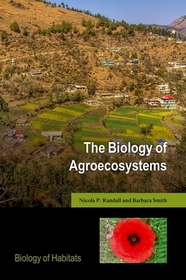
The Biology of Agroecosystems
Series: Biology of Habitats Series;
- Publisher's listprice GBP 52.00
-
24 843 Ft (23 660 Ft + 5% VAT)
The price is estimated because at the time of ordering we do not know what conversion rates will apply to HUF / product currency when the book arrives. In case HUF is weaker, the price increases slightly, in case HUF is stronger, the price goes lower slightly.
- Discount 10% (cc. 2 484 Ft off)
- Discounted price 22 359 Ft (21 294 Ft + 5% VAT)
Subcribe now and take benefit of a favourable price.
Subscribe
24 843 Ft

Availability
Estimated delivery time: In stock at the publisher, but not at Prospero's office. Delivery time approx. 3-5 weeks.
Not in stock at Prospero.
Why don't you give exact delivery time?
Delivery time is estimated on our previous experiences. We give estimations only, because we order from outside Hungary, and the delivery time mainly depends on how quickly the publisher supplies the book. Faster or slower deliveries both happen, but we do our best to supply as quickly as possible.
Product details:
- Publisher OUP Oxford
- Date of Publication 27 November 2019
- ISBN 9780198737537
- Binding Paperback
- No. of pages208 pages
- Size 234x156x11 mm
- Weight 348 g
- Language English 0
Categories
Short description:
This book provides a novel perspective on agroecosystems, summarising our current understanding of the basic and applied aspects of these important and complex habitats, whilst focusing on environmental concerns in the context of global change.
MoreLong description:
Since the advent of agriculture approximately 12,000 years ago, human activity has created a unique set of ecosystems. However, the recent development of world markets, rapid technological advances, and other changes to farming practices have led to hugely increased pressures on farm habitats and organisms. Global human populations are rising and diets are becoming ever more complicated, leading to unrelenting requirements for increased levels of food production. Natural biotopes are becoming increasingly fragmented as agricultural activities expand around them.
"Agroecosystems" now occur from the tropics to subarctic environments and comprise systems as varied as annual crops, perennial grasslands, orchards, and agroforestry systems. They presently cover almost 40% of the terrestrial land surface and significantly shape landscapes at a global scale. This key addition to the OUP Biology of Habitats Series provides a novel perspective on agroecosystems, summarising our current understanding of the basic and applied aspects of these important and complex habitats, whilst focusing on environmental concerns in the context of global change.
The Biology of Agroecosystemsis is for both senior undergraduate and graduate students taking courses in agroecology, farmland ecology, conservation, and agriculture as well as the many professional ecologists, conservation biologists, and land managers requiring a concise overview of agroecology.
The authors accomplished their goal for this book by providing readers with a thorough yet succinct background on agroecosystems, including the biological pressures and issues that must be considered in successful management of these complex systems. The Biology of Agroecosystems would be beneficial to students, land managers, and researchers with an interest in balancing agricultural production and natural resource conservation.
Table of Contents:
Introduction
Agricultural environments
Biodiversity
Biotic interactions and ecosystem functioning
Soils
Water (hydrology)
The Biological Impacts of Globalization of Agriculture
Conservation and sustainable management of agroecosystems
Future perspectives

